A single smart lock lasting “one year” means something very different in a 100-door or 200-door project. In a single-door setting, a flat battery may affect one household; across many doors, the same failure rate is multiplied by door count and adds site visits, waiting time, complaints and emergency unlocking costs. The real project question is not simply “How long will the battery last?” but how to make failures predictable, batch-manageable and controllable.
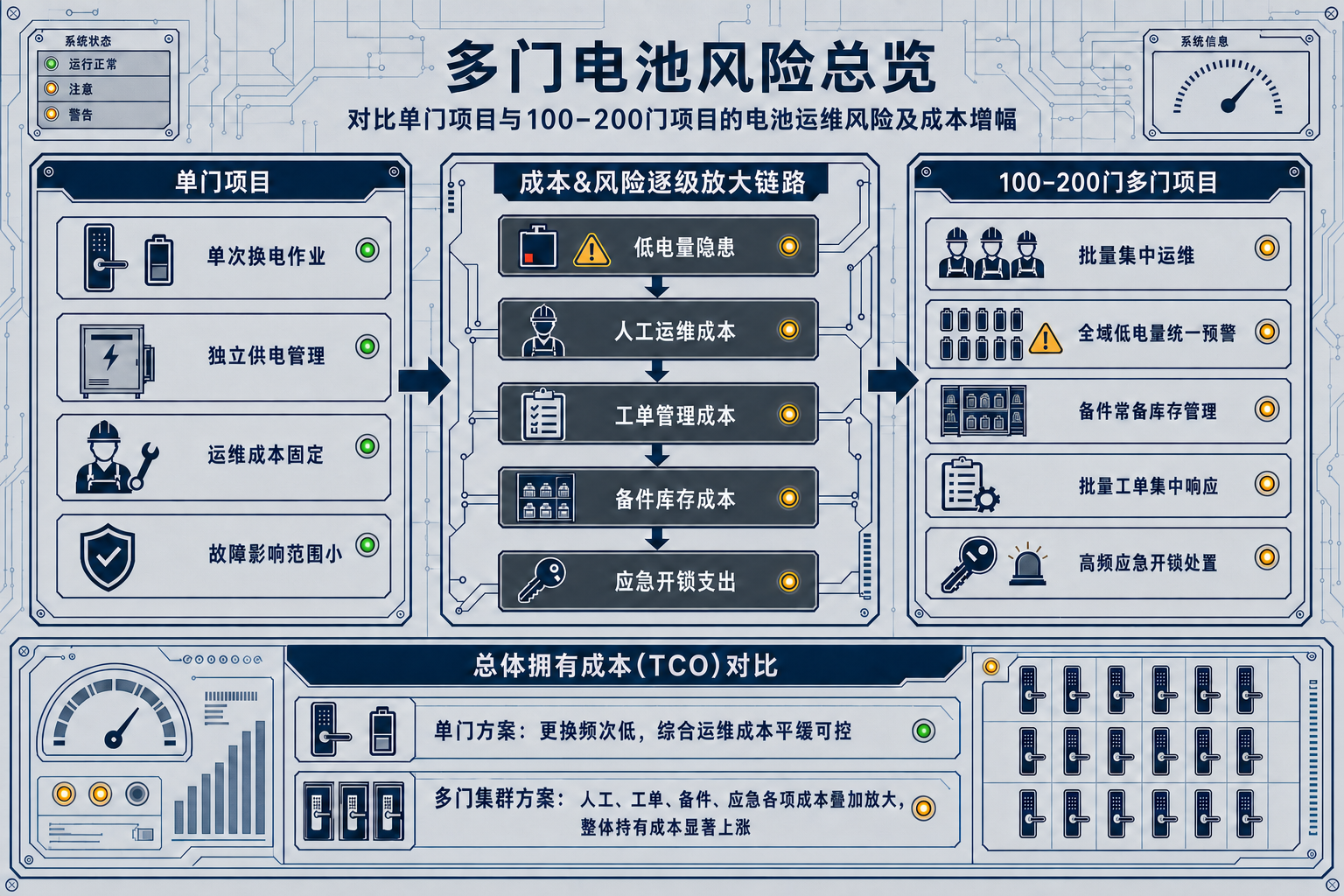
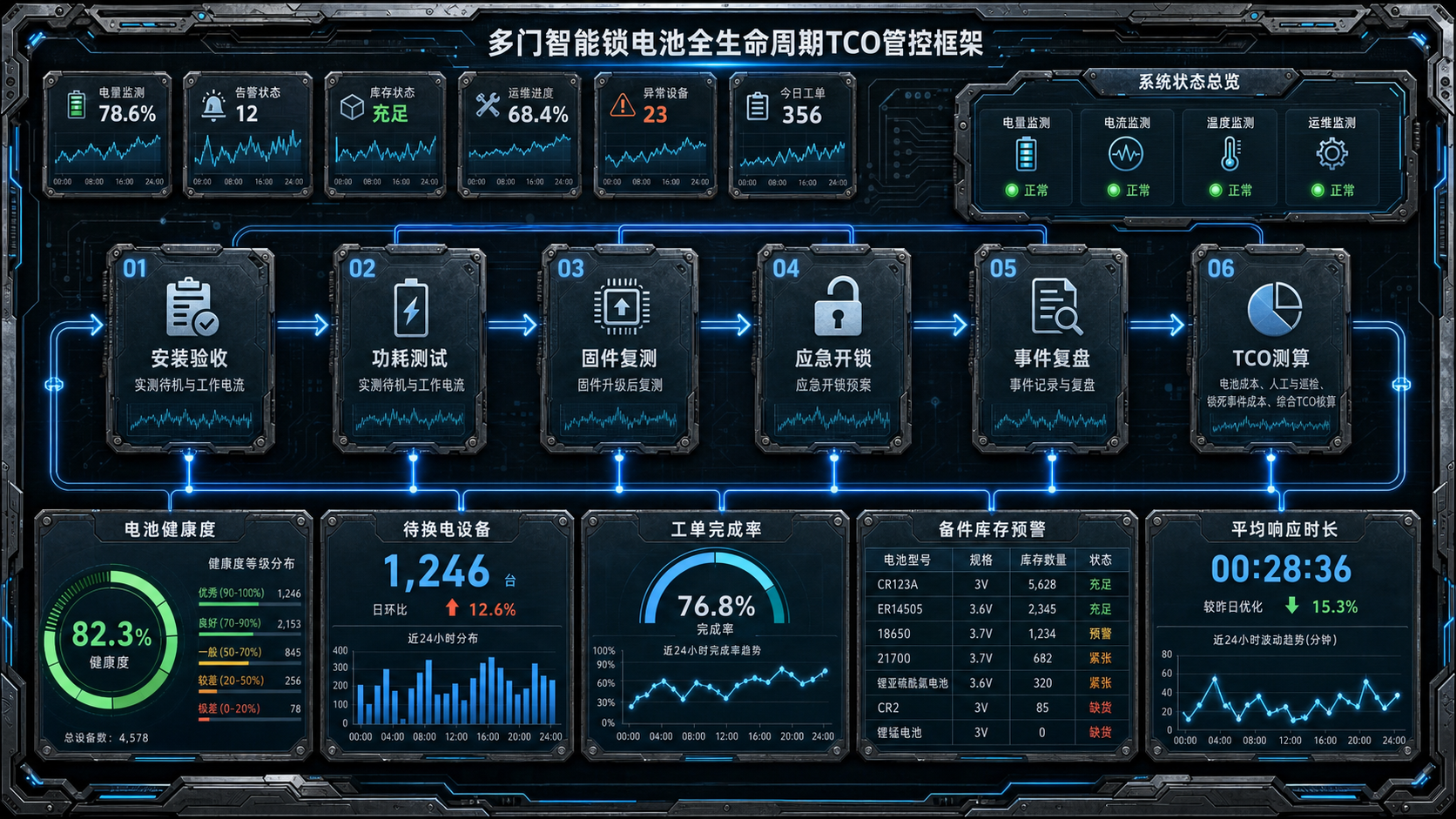
This article focuses on battery-powered smart locks and does not cover central power, PoE or AC-powered systems. It follows a practical sequence: identify variables, select batteries, set project strategies, establish alerts, validate power consumption, prepare emergency access and calculate TCO.
FAQ: Quick answers to common questions
How long do batteries usually last?
It depends on opening frequency, communication method, motor load and ambient temperature. A low-traffic apartment may reach 12–18 months, while a high-traffic hotel may fall to 6–9 months. Projects should not rely on one generic rated figure.
How can a multi-door project avoid a wave of flat batteries?
Split installation and maintenance by building, floor or zone. Stagger and rotate replacement so a concentrated failure wave becomes a steady stream of small, controllable tasks.
Why does runtime drop noticeably in winter?
Low temperatures can reduce discharge capability, harden seals and increase latch resistance, forcing the motor to draw more starting current.
When should batteries be replaced early?
After a low-battery alert, consider remaining capacity, usage frequency and the next maintenance window. Do not wait for a lockout event.
Must a multi-door project connect to a management platform or PMS?
Not necessarily, but as door count grows, low-battery alerts, work orders, permissions and maintenance records increasingly depend on a platform. Projects with more than 50 doors should seriously evaluate systematic management.
Part 1: Four variables that determine battery life
Battery life is not a fixed number printed by the lock manufacturer. It is the result of access behaviour, communication strategy, mechanical load and environmental conditions.
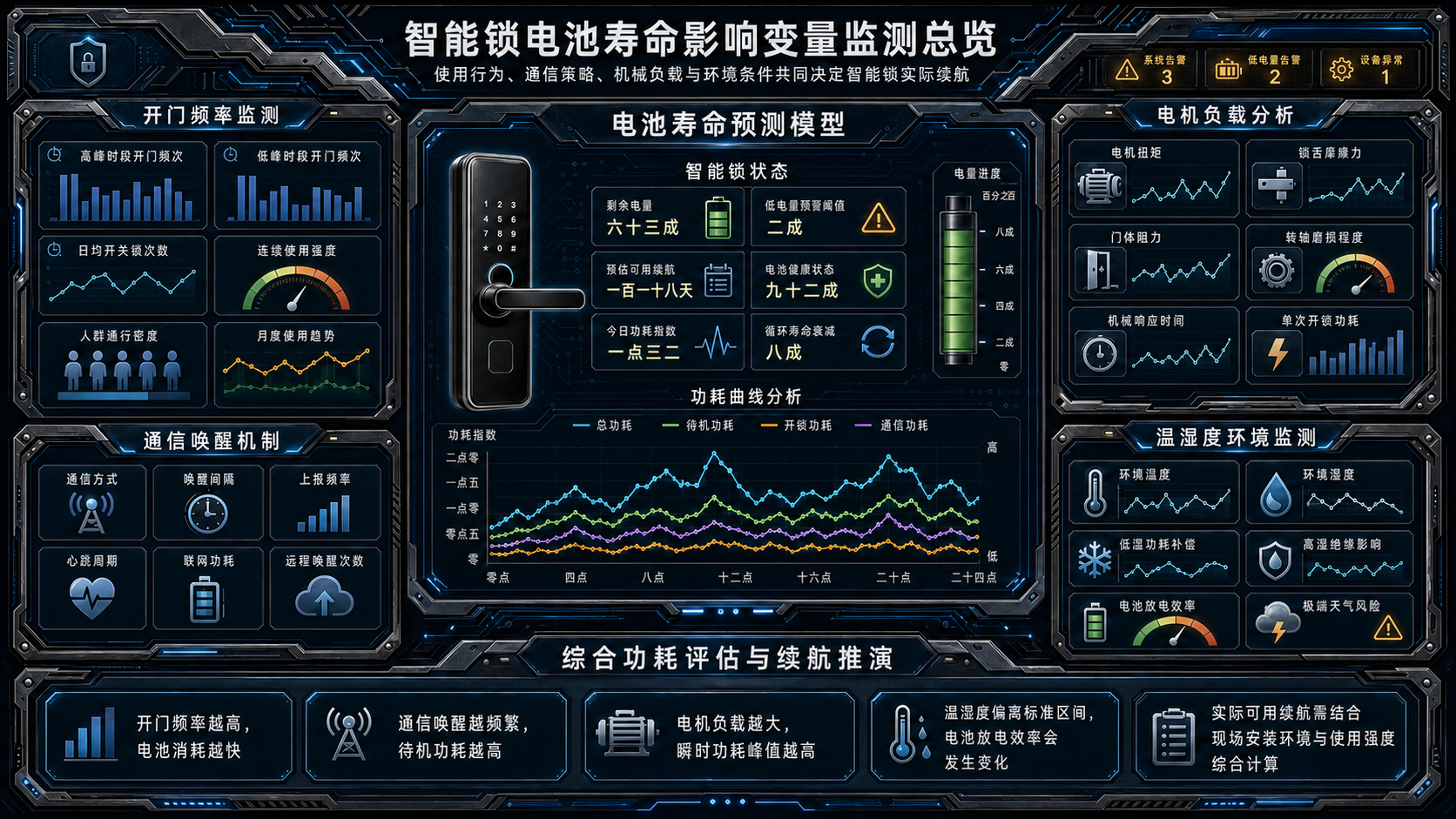
Variable 1: Opening frequency and peak periods
Every unlock triggers the motor and consumes far more energy than standby. Peak opening periods in hotels and offices can subject batteries to repeated high-current discharge in a short time.
Variable 2: Communication method and wake-up mechanism
Direct Wi-Fi typically consumes more power than Bluetooth, Zigbee or LoRa. Always-on operation, scheduled reporting and event-triggered wake-up also produce different standby profiles.
Variable 3: Motor torque, door resistance and multipoint rods
Door misalignment, latch friction, spindle resistance and multipoint rods can increase starting current and drive time. The same lock may deliver noticeably different runtime on different doors.
Variable 4: Temperature, humidity and installation environment
Low temperature affects discharge, high temperature accelerates self-discharge, and high humidity can oxidise contacts or cause leakage. Outdoor corridors, basements and semi-open areas require separate assessment.
Part 2: Match battery type to the lock environment
Battery chemistries differ significantly in voltage characteristics, discharge curves, low-temperature performance, self-discharge and pulse-current capability. Select batteries together with lock load and maintenance capability.
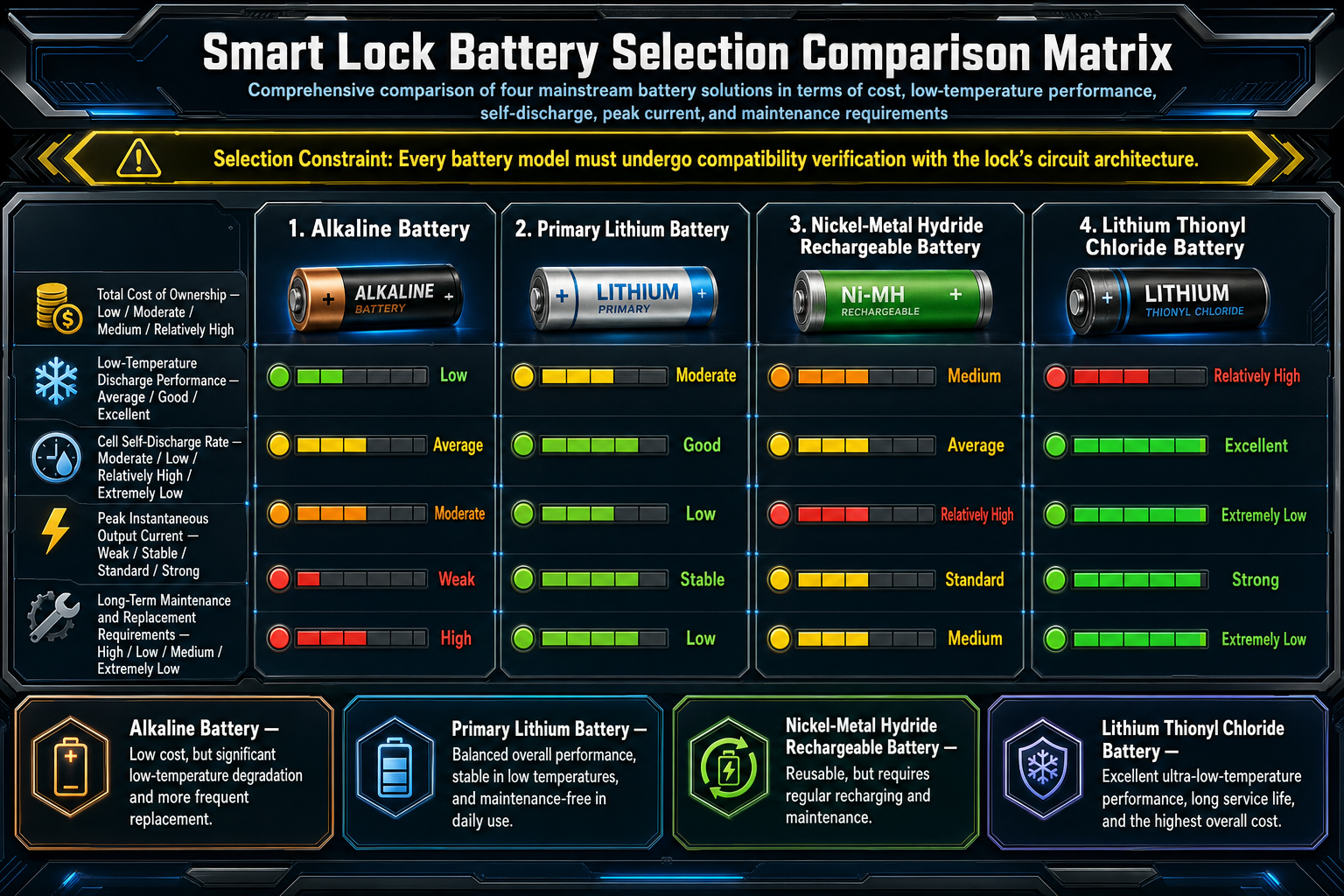
| Battery type | Typical characteristics | Suitable applications |
|---|---|---|
| Alkaline battery | Low cost and easy to source; average low-temperature and self-discharge performance | Low-traffic, temperate projects with convenient maintenance |
| Primary lithium battery | High energy density, good low-temperature performance and low self-discharge | High-traffic or cold environments |
| Nickel-metal hydride battery | Rechargeable, but requires charging management | Operators with maintenance capability |
| ER-series lithium-thionyl chloride battery | Wide temperature range and long standby, but pulse-current capability must be confirmed | Low-power, long-cycle applications |
Part 3: Choose a strategy for the project profile
Apartments and long-term rentals
Low traffic does not mean simple maintenance. Prioritise long-life batteries and include tenant handover checks, alert notifications and maintenance windows in the property workflow.
Hotels
Hotel traffic is high, so replacement should follow occupancy and room-out-of-service windows. PMS room-status data can schedule maintenance, with backup power prepared for peak-period risks.
Offices and commercial buildings
Opening activity concentrates on weekday peaks. Holidays can provide batch-replacement windows, while voltage sag and unlock success should be verified during peak periods.
Batch residential projects
Define responsibilities for owners, tenants, property teams and suppliers in advance, and establish common alert, spare-parts and emergency-response processes.
The common conclusion across all four project types is that the strategy is not simply “which battery to choose”; it is a predictable, batch-ready maintenance mechanism with clear ownership.
Part 4: Low-battery alerts and batch maintenance
The goal of a multi-door project is to turn reactive failures into proactive maintenance. Thresholds, alert channels, maintenance windows, inventory, work orders and ownership must form a closed loop.
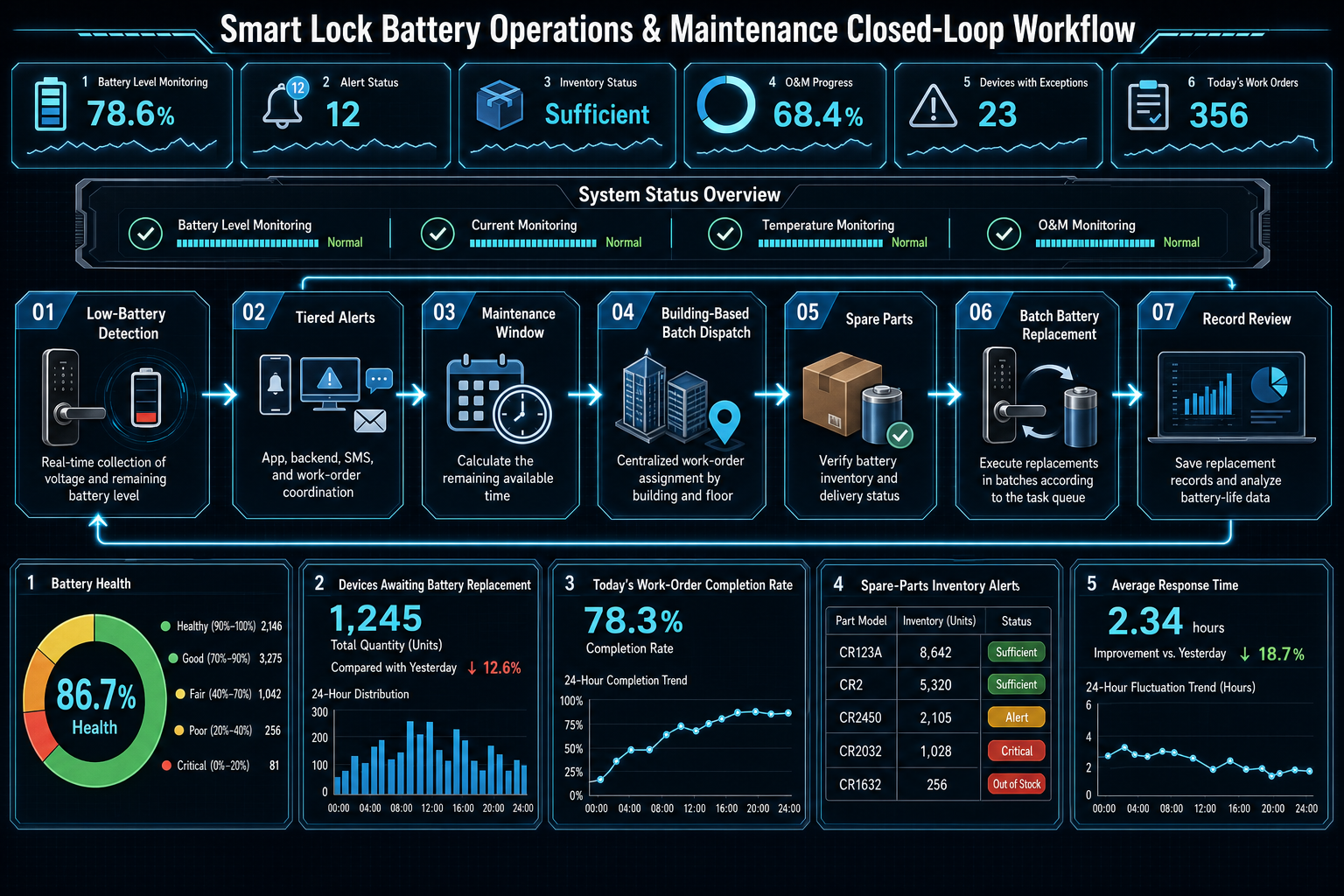
Alert thresholds and notification channels
Thresholds must not be set too low; leave enough time between alert and replacement. App and backend alerts support daily operations, while SMS and work orders can be used as depletion approaches.
Rotate replacement by building, floor and batch
Group the project by building, floor or zone and stagger replacement so maintenance resources remain manageable.
Spare-parts inventory and ownership
Record replacement time, location and battery batch to support future prediction. Put in writing who owns inspection, replacement, overnight emergencies and spare-parts cost.
Part 5: How installation, firmware and communication settings affect power use
Door misalignment, latch friction, reporting frequency, wake-up strategy and firmware updates can all change actual runtime. Balance runtime, response speed and online rate according to project priorities.
- Calibrate door alignment and latch resistance
- Verify that motor starting current is within the expected range
- Check reporting frequency and wake-up strategy
- Measure standby and operating current against the selection assumptions
- Re-test power consumption after firmware updates
Part 6: Emergency unlocking and lockout response
Mechanical keys, external power contacts, USB-C or another emergency power method should be standard and tested regularly. Record the cause, response time and outcome of every lockout to refine alert thresholds.
Part 7: Questions to confirm with the supplier before deployment
- What opening frequency, temperature and battery model were used in the runtime test?
- What are the low-battery thresholds, notification methods and API capabilities?
- What backup power, emergency unlocking and spare-parts lead times are available?
- Can OTA affect power consumption, and how are after-sales response times and the SLA agreed?
Part 8: TCO calculation for multi-door projects
Total cost = battery cost + replacement labour + inspection cost + lockout handling cost + backup power and spare-parts cost + system maintenance cost.
Define lock count, expected replacements per door, battery cost per replacement, hourly labour cost, region, system integration, emergency events and a three- or five-year horizon. The table is illustrative; replace its assumptions with supplier quotations and local labour rates.
| Scenario | Doors | Annual replacements/door | Primary cost drivers |
|---|---|---|---|
| Apartment | 100 | 1 | Site labour; low-traffic long runtime |
| Office | 100 | 1.5 | Weekday peaks; holiday replacement windows |
| Hotels | 200 | 2 | Frequent replacement; system linkage; emergency cost |
Conclusion
Battery management in a multi-door project upgrades the question from “How long will one lock last?” to “How can failures be predictable, batch-manageable and controllable?” From life variables and battery selection to alerts, batch maintenance, power validation, emergency planning and TCO, every step lowers lockout risk and hidden operating cost.
Get a tailored battery-replacement-cycle estimate:Tell us your property type, door count, access frequency, communication method and maintenance needs, and we will prepare a project-specific plan.