This article is a B2B evaluation framework, not legal advice. Consumer protection, product liability, data protection and dispute-resolution requirements must be reviewed professionally for the relevant market and contracting parties.
A smart lock OEM project does not end at delivery. Spare parts, firmware, cloud service, warranty, RMA and traceability determine whether a brand, distributor or project team can manage operations over the long term. This checklist helps teams document responsibilities and evidence before ordering and mass production.
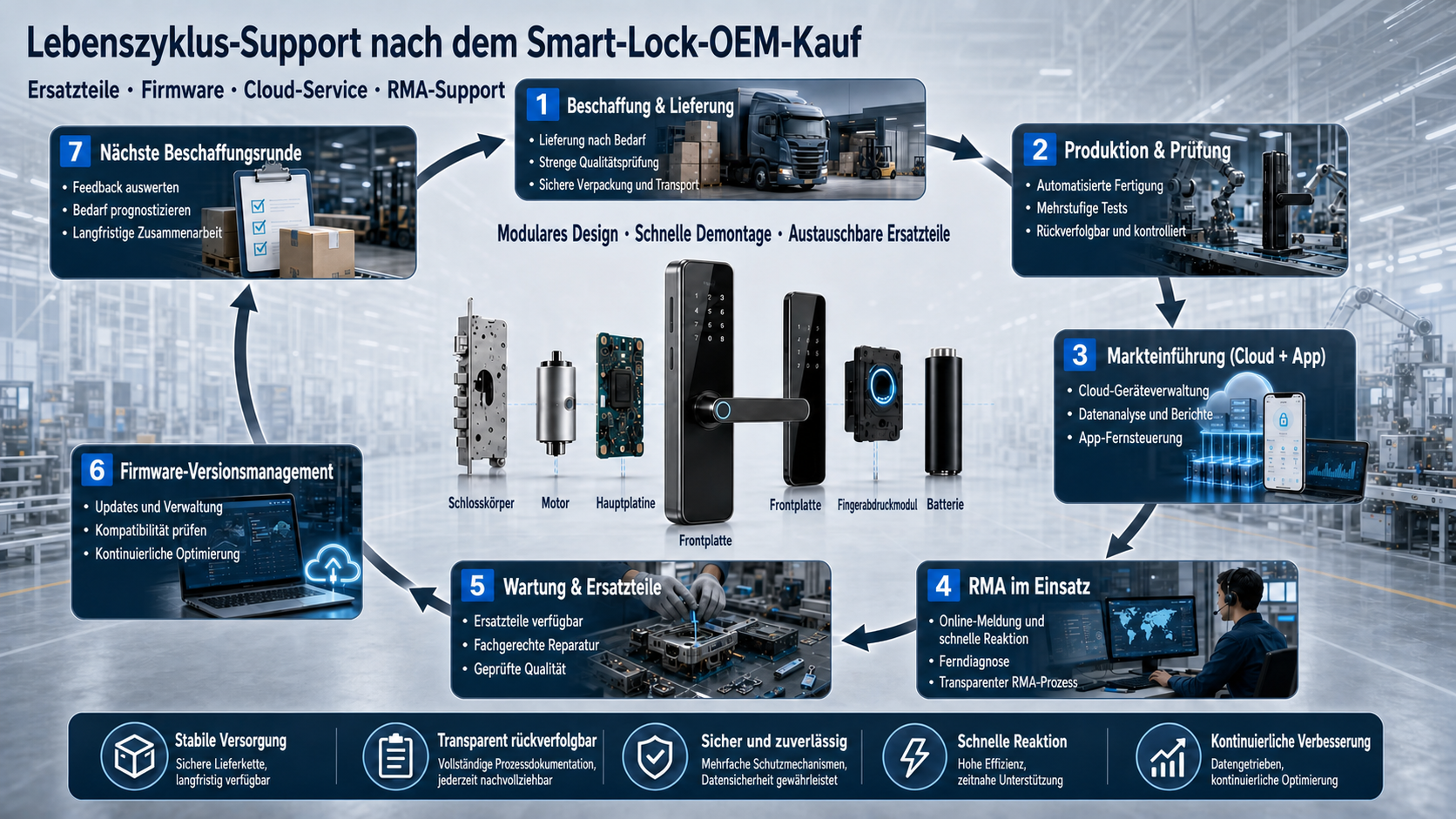
After-sales responsibility: clarify the boundaries first
Connected smart locks involve brand owners, OEM manufacturers, app or cloud providers, distributors and installers. Without documented interfaces, a technical fault can quickly become a general service issue. For every product configuration, define who receives faults, who analyses them, who approves changes and who communicates with customers.
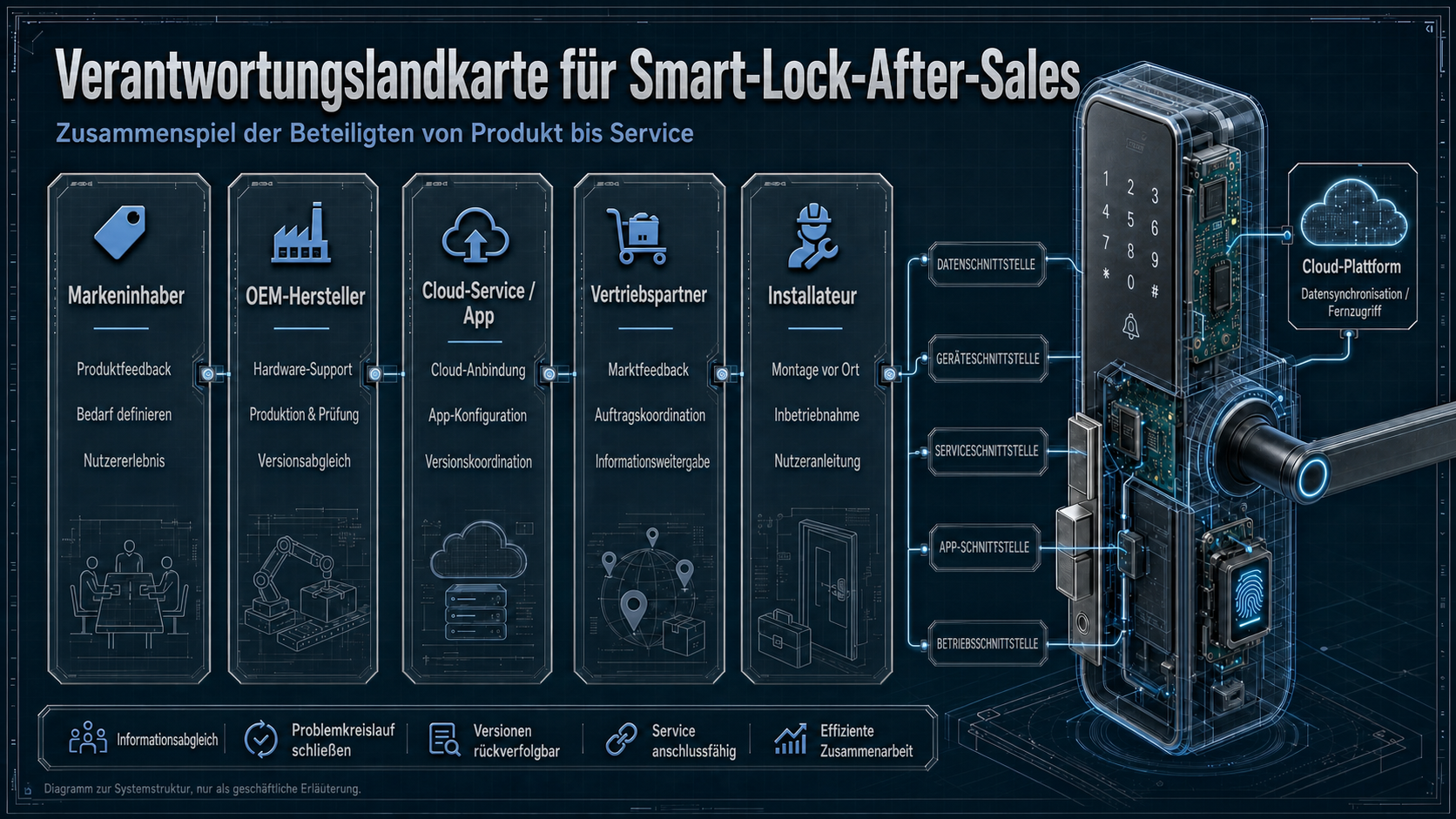
| Party | Define in writing before launch |
|---|---|
| Brand owner / buyer | Target markets, product version, delivery scope, escalation contact and customer communication. |
| OEM manufacturer | Hardware diagnosis, spare parts, production and test records, and version approvals. |
| App or cloud provider | Accounts, data access, interfaces, updates, incident reporting and end of service. |
| Distribution and installation | Installation conditions, on-site fault capture, feedback and user instructions. |
Plan spare parts: availability, discontinuation and alternatives
Spare parts are not only an inventory question. For the lock body, motor, main PCB, front panel, sensors and batteries, agree the availability period, discontinuation notice, service-parts approval, final-order window and documentation for compatible versions.
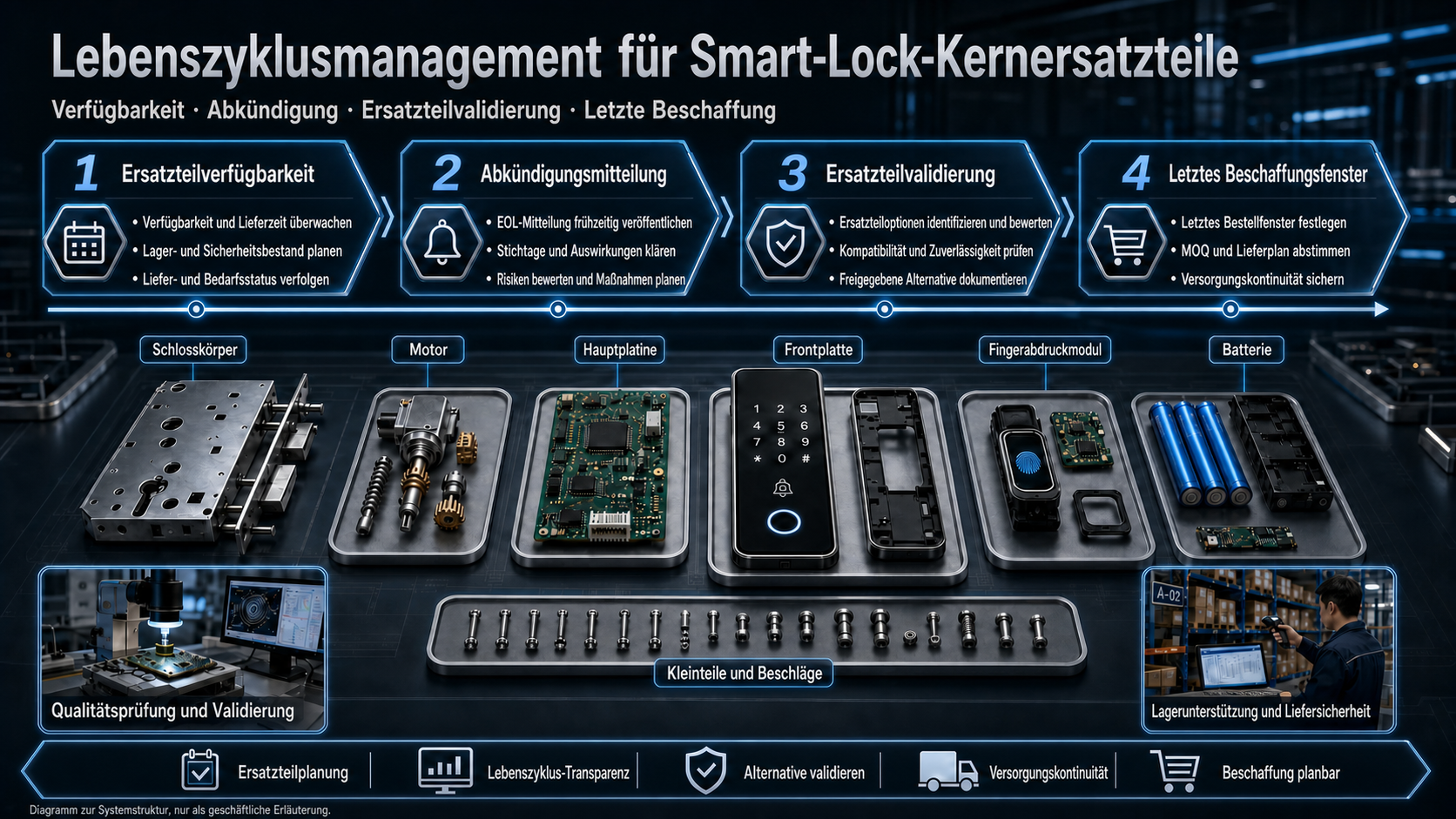
Frame service-part periods as procurement questions
Do not rely only on a promise of “long-term availability.” Request a project-specific statement explaining the affected components, how changes are announced, which minimum quantities apply and how service-part approval is evidenced. Required quantities depend on installed volume, fault patterns, stocking strategy and service channels.
For concealed-lock projects, installation space, door construction and mounting method affect serviceability. The invisible lock battery-life guide and engineering selection guide for invisible locks can help teams assess power, mechanical movement and service access from the sample stage.
Firmware and cloud service: do not mix versions with responsibilities
Where an app, gateway or cloud connection is involved, hardware, PCB, firmware, app, gateway and interfaces should be versioned separately. Agree the reporting route, prioritisation, update approval, recovery after failed upgrades, data access and limits of customer-specific maintenance.
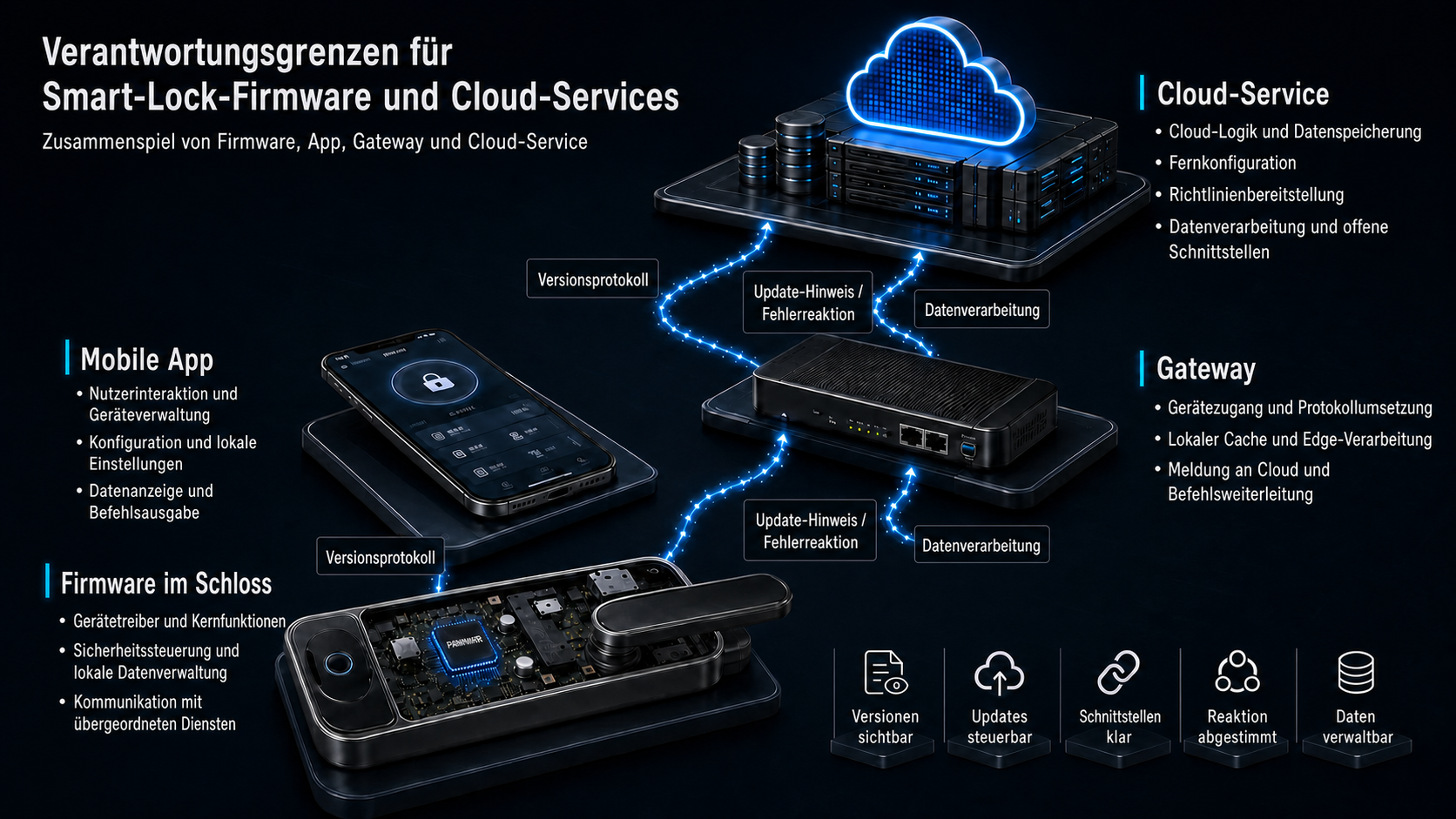
- Version control: Identify hardware, PCB, firmware, app, gateway and cloud interfaces clearly; archive sample and production versions.
- Fault handling: Define reporting, initial response, corrective action, verification and customer communication by fault type.
- Data and accounts: Set project-specific rules for data types, ownership, retention, access and security measures.
Warranty boundaries: break “free” into verifiable terms
A general warranty statement is not enough. Clarify the start date, duration and scope for hardware, software service, finishes, consumable parts, installation quality, unauthorised changes and network conditions.
| Review point | Question to settle in the agreement |
|---|---|
| Covered items | Who is responsible for the lock body, motor, PCB, sensors, front panels, accessories, app and cloud service? |
| Operating conditions | Are door type, installation, temperature, humidity and usage covered for the market and project? |
| Diagnosis | Who performs initial diagnosis, when is a return required and how are external causes documented? |
| Remedy | When do repair, parts replacement, device replacement or a replacement unit apply? |
RMA process: create a clear path for every return
A robust RMA process starts with a verifiable fault description, not product shipment. The serial number, hardware and firmware versions, fault symptoms, photo or video, installation status and prior steps shorten remote diagnosis.
| Step | Data to submit | Agreed outcome |
|---|---|---|
| Fault report | Serial number, version, fault symptoms, visual evidence and time of occurrence | Case number, contact person and next checks |
| Remote diagnosis | Installation, power supply, door movement, network and app information | Diagnosis, return decision and missing data |
| RMA approval | RMA number, address, packing and customs information | Logistics and cost arrangement, processing steps |
| Repair or replacement | Test record, affected parts and versions | Repair report, replacement and installation instructions |
| Recurring fault | Affected lot, fault pattern, quantity and immediate actions | Joint investigation and communication plan |
Capture a fault report completely
In addition to statements such as “the door will not open,” teams should document opening direction, installation condition, battery or power supply, frequency, update history, mechanical emergency opening and checks already performed. This does not replace a responsibility decision, but gives all parties the same diagnostic basis.
Traceability: link every lock to a version
A unique product record should connect the serial number, production lot, PCB and firmware version, lots of key modules and factory test record. When a deviation occurs, this helps limit the affected scope instead of treating all stock alike.
For RFQs and factory audits, also review the smart lock factory audit guide and the article on OEM/ODM quality control so production records, version management and after-sales feedback work together.
20 questions before ordering: a negotiation checklist
Spare parts and lifecycle 4 questions
- How is the availability period for devices and key components calculated?
- How are discontinuation and shortage notices issued?
- Is there a final-order window, MOQ and confirmed stock availability?
- How is compatibility among the lock body, motor, PCB, front panel and sensors documented?
Warranty and operating conditions 3 questions
- What are the start date, term and covered items of the warranty?
- How are installation faults, non-standard power supplies and unauthorised changes assessed?
- Are door types, temperature, humidity and installation conditions included in the specification?
Firmware, app and cloud 4 questions
- Who maintains the firmware, app, gateway and cloud service?
- How are security or connectivity issues reported, prioritised, corrected and communicated?
- How is core functionality maintained after an update failure or service outage?
- Who manages data, accounts, logs and access rights?
RMA and recurring faults 4 questions
- What photos, videos, version and installation data does an RMA require?
- How are logistics, customs, diagnosis, repair and replacement handled?
- What diagnosis, repair or replacement records does the manufacturer provide?
- When does a joint investigation of a recurring fault begin?
Traceability, training and agreement 5 questions
- What serial, lot, PCB, firmware and test data is available for each lock?
- Who provides and updates installation, diagnostic and training materials?
- How do parties work together when an issue involves a third-party app, cloud service, sensor or radio module?
- Have market, contractual and dispute issues been professionally reviewed?
- Are all commitments recorded in the agreement, specification or service appendix rather than only discussed verbally?
Request an after-sales review checklist for your smart lock project
Tell WAFU your lock type, target market, expected order volume and current challenges, such as firmware maintenance, spare-parts availability, warranty boundaries or RMA turnaround. We can help structure the technical and delivery-related points for your OEM/ODM project.