When evaluating smart lock solutions, hardware selection directly impacts project success and long-term maintenance. A modular evaluation framework is the foundation for rational decision-making: the main control scheme (ARM Cortex-M vs. RISC-V) determines the balance between algorithm capabilities and power consumption; the communication module (Wi-Fi 6E vs. NB-IoT vs. Zigbee 3.0) affects network stability and integration costs; and the lock body structure (fully automatic vs. semi-automatic) relates to mechanical lifespan and scenario adaptability. Technical strength is also reflected in implicit designs such as PCB electromagnetic compatibility optimization and firmware OTA robustness. A supplier's complete signal integrity report and thermal simulation data are more valuable than advertised parameters.
In-depth Hardware Architecture Analysis: The Technical Foundation for Integrability and Customization
Hardware architecture determines the product's scalability and long-term technological evolution path. Evaluation must go beyond surface parameters and focus on the flexibility and robustness of the underlying design.
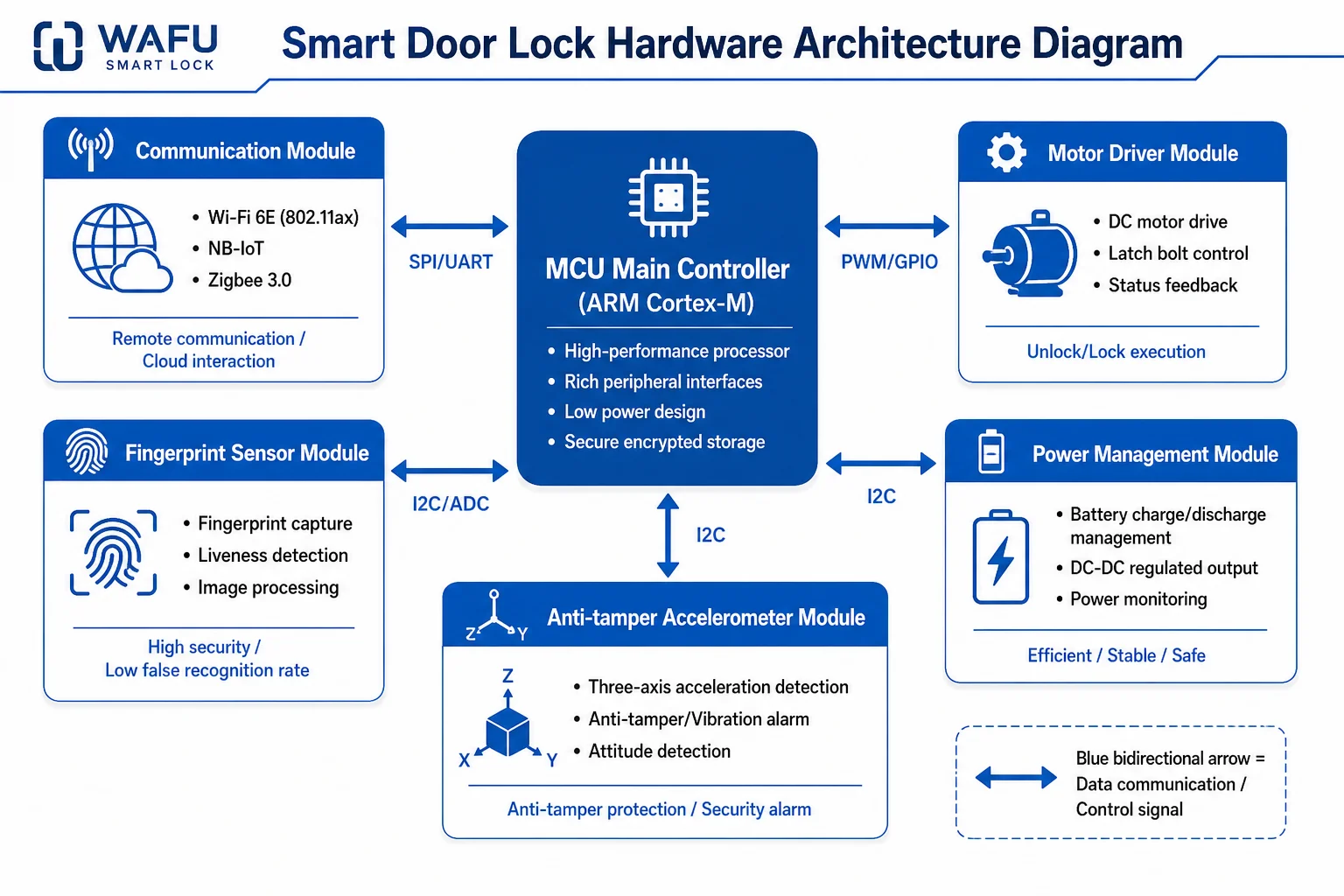
Lock Body Structure: Dual Considerations of Security and Commercial Adaptability
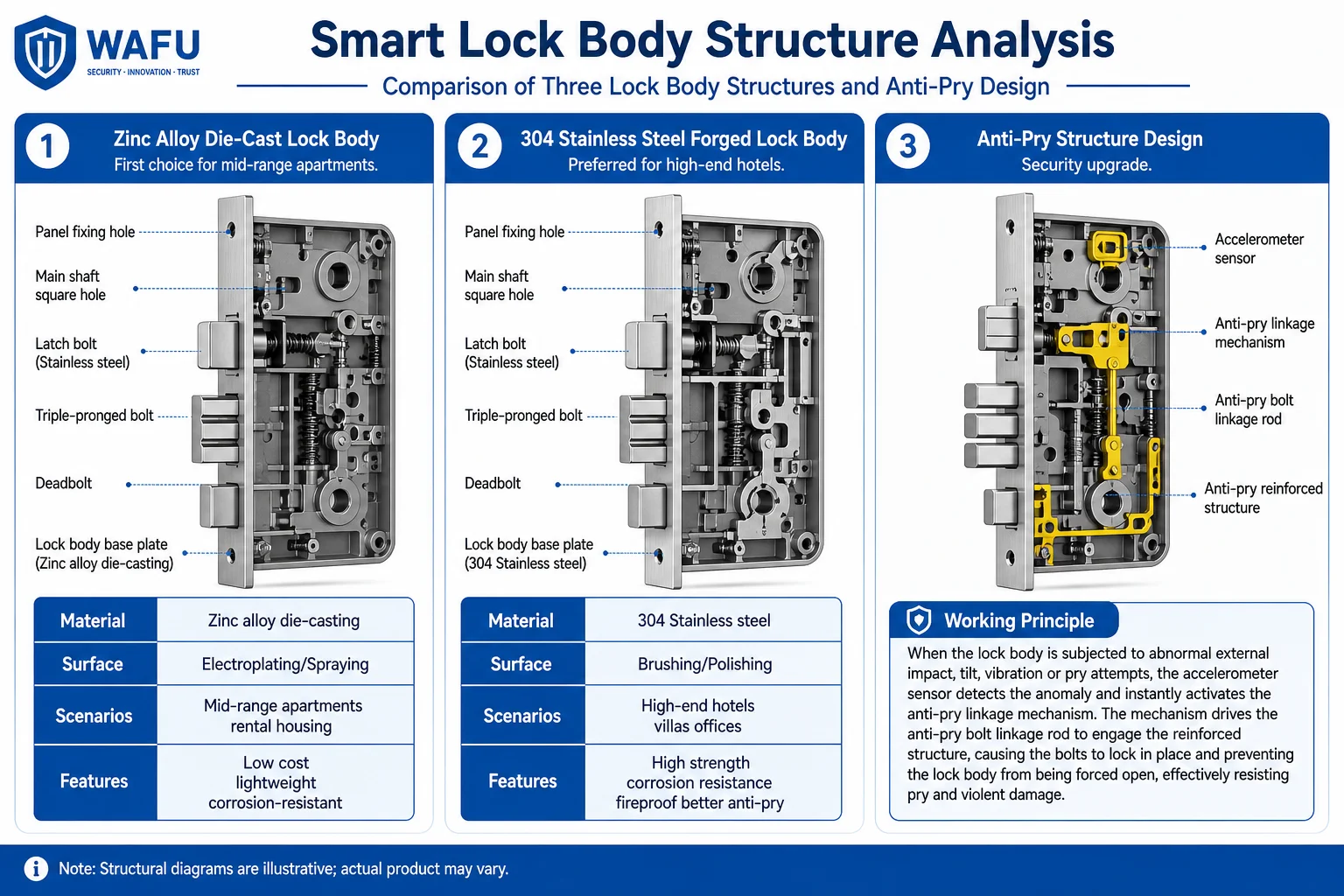
Lock body design must balance security and commercial scenarios. The tamper-proof structure uses an accelerometer linked to the anti-pry latch; abnormal vibration triggers a local alarm and uploads the data to the cloud. Material selection requires quantitative evaluation: die-cast zinc alloy is suitable for mid-range apartments, costing approximately 30% less than 304 stainless steel, and has a lifespan of up to 100,000 cycles; forged 304 stainless steel is geared towards high-end hotels, offering stronger corrosion resistance, but costs approximately 45% more than zinc alloy.
Identity Authentication Module: Flexible Design Covering Multiple Scenarios
The fingerprint recognition solution follows the principle of scenario adaptation: optical sensors perform stably in humid environments (such as pool changing rooms), with a false recognition rate of <0.001%; semiconductor sensors are 40% faster than optical sensors in dry offices, but require anti-static design. Multiple authentication strategies require customization: nursing homes use "fingerprint + IC card"; rental apartments use "temporary password + Bluetooth"; offices recommend "fingerprint + face". Modular design supports quick on-site sensor replacement.
Communication Module: The Key to Project Integration Success
Dual-mode or multi-mode communication backup is standard for large-scale projects: Wi-Fi 6E provides high-bandwidth remote management, while NB-IoT can automatically take over in signal dead zones (such as underground parking garages), ensuring a 99.9% online rate. Protocol compatibility determines integration costs: the Zigbee 3.0 standard protocol supports seamless integration with mainstream smart home platforms; proprietary protocols may increase development time by 30% compared to standard protocols. Therefore, engineering teams should prioritize evaluating existing system architectures; open protocol stacks can significantly reduce long-term maintenance risks.
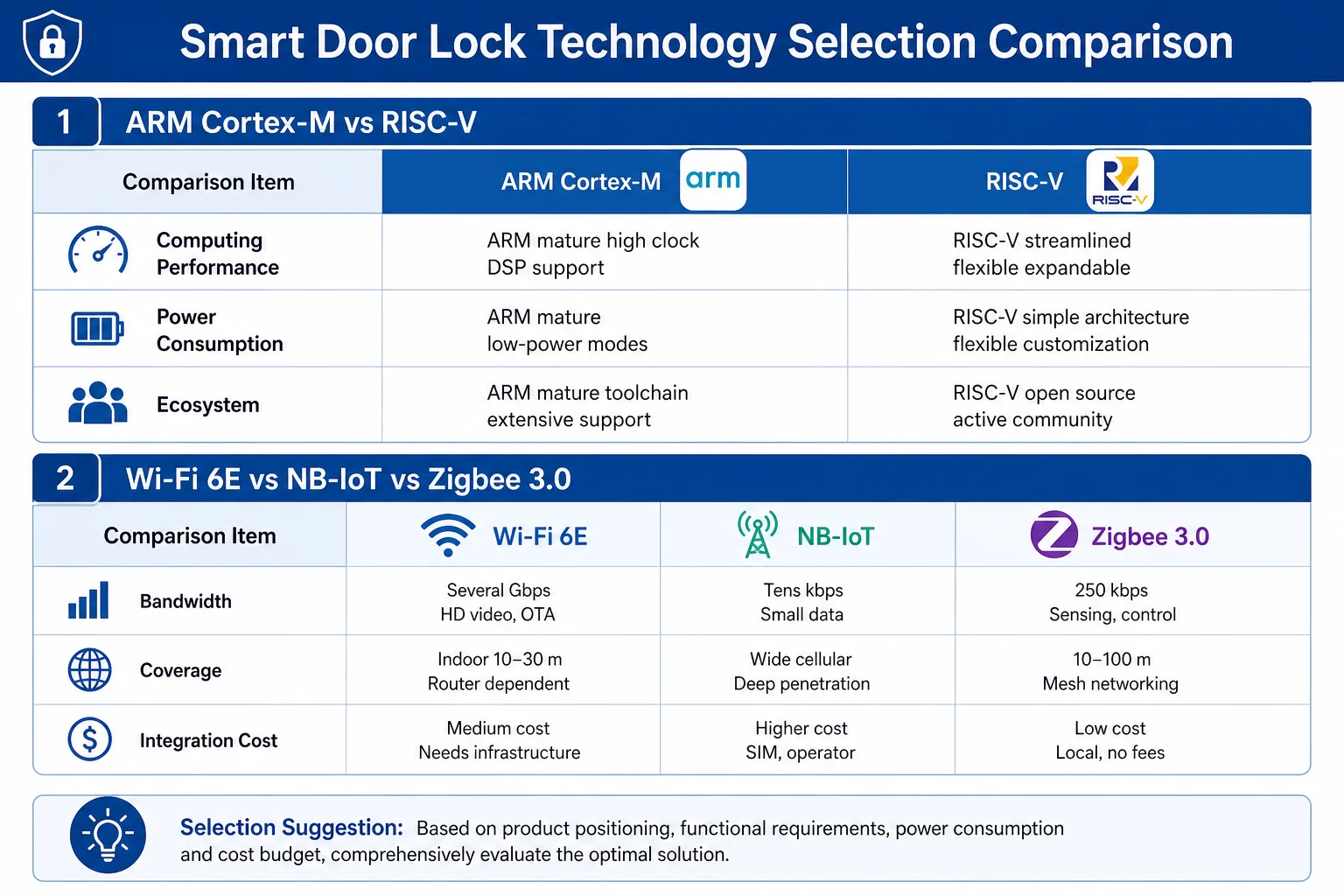
| Comparison Dimension | Core Advantages | Typical Scenarios | Integration Risks & Notes |
|---|---|---|---|
| ARM Cortex-M (MCU Architecture) | Mature ecosystem, rich SDK / toolchain | Multi-modal biometric identification for smart locks (face / fingerprint) | Low — complete supporting development system |
| RISC-V (MCU Architecture) | Open source and free, low licensing cost, flexible architecture | Low-cost mass production and deployment of devices | Medium — industry ecosystem is still improving |
| Wi-Fi 6E (Wireless Protocol) | High bandwidth, fast transmission rate, suitable for remote high-definition maintenance | Cloud remote management of smart locks in apartments / residential areas | Medium — overall power consumption is high, not conducive to long-term battery power supply |
| NB-IoT (Wireless Protocol) | Ultra-low power consumption, wide coverage, strong penetration capability | Underground garages, corridors, long-distance weak signal areas | Low — PSM power-saving mode is mature, module standardization |
| Zigbee 3.0 (Wireless Protocol) | Low power consumption, unified standards, Mesh self-networking, easy integration | Whole-house smart home linkage, multi-device networking and docking | Low — networking protocol is mature, compatible with mainstream platforms |
Power Management: A Commercial Consideration for O&M Efficiency
The "2-Year Battery Replacement-Free Design" is achieved through dynamic power consumption management: sleep current <15μA, wake-up response <200ms. North American long-term rental apartment cases show that this design can reduce annual maintenance costs by approximately $42 per lock. Emergency power supply uses supercapacitor backup, supporting 3 emergency unlocks, creating redundancy with mechanical keyholes. During batch deployment, remote power monitoring can provide early warnings for replacement windows, effectively avoiding large-scale after-sales maintenance.
Software Systems: The Hidden Value of SDK/API Support and Secondary Development Capabilities
In B2B scenarios, the openness, customizability, and depth of security algorithms in software often determine the efficiency of project implementation and the final user experience.
Security Algorithms: From Compliance to Verifiability
Security algorithms translate compliance requirements into configurable technical parameters. Input error locking policies can be configured through the backend interface, including locking thresholds and durations: For example, a typical apartment can be set to "5 errors, 3 minutes lock," while a financial warehouse can be set to "3 errors trigger remote alarm and permanent lock." The duress alarm integration complies with the European EN 14846 standard, providing standardized API interfaces (e.g., /api/v1/emergency/duress), supporting seamless integration with security systems, with alarm latency <2 seconds.
The Operational Value Transformation of User Experience Algorithms
The fingerprint learning algorithm employs adaptive template update technology. After the first verification of a new fingerprint, the stored template is automatically optimized, reducing the frequency of manual resets by administrators due to fingerprint issues by 67%. The algorithm continuously learns changes in user pressing habits (e.g., fingerprint wear, seasonal dryness/wetness), maintaining a false rejection rate of <0.5% while improving recognition speed. Batch management is achieved through a cloud-based console: remote firmware differential upgrades can be performed on thousands of door locks (saving 85% of bandwidth), configuration parameters support group push, and full synchronization can be completed within 10 minutes.
Open Interfaces and Customization Capabilities
The modular SDK supports hot replacement of communication modules: modifying the configuration file COMM_PROTOCOL=ZIGBEE_3.0 can replace the Wi-Fi module with Zigbee without rewriting the core logic. API integration provides both RESTful and WebSocket channels: property management systems can generate temporary passwords via POST /locks/{id}/temporary-password; hotel PMS can receive door lock status events (door opening records, battery level, alarms) via WebSocket. The interface documentation clearly defines the request/response format, authentication mechanism (OAuth 2.0), rate limit (1000 times/minute), and error codes; integration according to this documentation can be completed in just 5 person-days.
Technical Compliance: A Technical Passport for Global Market Access
Technical Requirements for European and American Markets
The European and American markets require compliance with multiple technical standards: ANSI/BHMA A156.25 standards require a mechanical life of 250,000 cycles for residential use and 500,000 cycles for commercial use. CE/FCC certification focuses on radio module compliance: Wi-Fi 6E modules must pass EN 300 328 radiation testing, with a transmit power limited to below 20dBm, and meet FCC Part 15B electromagnetic compatibility requirements. GDPR privacy protection requirements: User biometric data must be encrypted and stored locally on the MCU (AES-256), with only hash values transmitted to the cloud; cross-border data transmission must use TLS 1.3 encrypted channels.
Adaptive Design for the Asia-Pacific Region
The Asia-Pacific market needs to address diverse environmental challenges: High-temperature and high-humidity environments (such as Southeast Asia) require lock bodies with IP65 protection ratings, circuit boards with a conformal coating (thickness ≥25μm), and connectors with gold-plated contacts. Regarding localization adaptation: Japan requires compliance with JIS A 1510 fire resistance standards (lock body fire resistance ≥30 minutes); South Korea requires support for TTA standardized communication protocols (such as Wi-SUN); many Southeast Asian countries require support for dual-SIM NB-IoT modules to achieve automatic switching between operator networks. The power management system needs optimization to ensure battery life degradation rate <15% in a 40°C/95%RH environment.
Industry Application Scenarios and Technical Solutions Matching
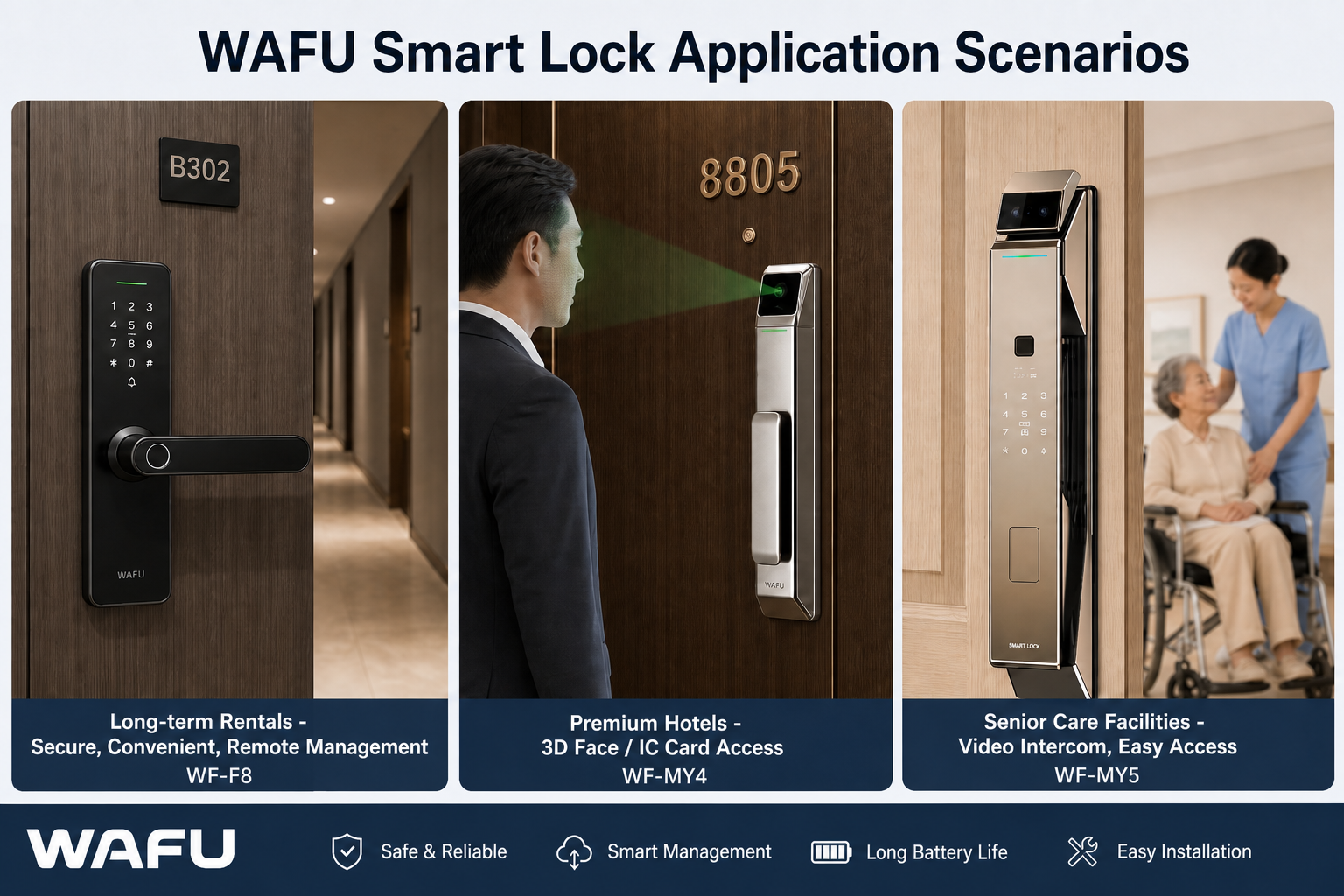
Long-term rental apartment scenario: The technical solution must meet the "2-year battery replacement-free" maintenance requirement: power management system sleep current <12μA, combined with NB-IoT low-power communication (PSM mode duty cycle 0.1%), achieving 24 months of battery life. During batch deployment, rapid pairing of hundreds of door locks can be achieved via Bluetooth Mesh networking (<30 minutes), and the cloud platform supports remote firmware differential upgrades and batch configuration pushes.
Hotel and office scenarios: High-traffic scenarios require a fully automatic lock body solution, with mechanical life testing exceeding 500,000 cycles (compliant with ANSI/BHMA A156.25 commercial grade). The motor drive employs closed-loop control, with an unlocking time of <0.8 seconds and noise level <45dB. The temporary password generation system integrates access control: hotel PMS generates time-limited passwords (e.g., valid for 4 hours) via API; office scenarios support hierarchical authorization (department managers can generate temporary passwords for subordinate areas).
Elderly care and medical scenarios: The emergency alarm function requires standardized integration with the medical system: after the door lock's built-in SOS button is triggered, an alarm data packet (including location, time, and door lock ID) is sent to the medical platform via HTTPS, with a response delay of <1.5 seconds. The simplified user interface uses large font (≥18pt) icons, supports voice guidance, and the fingerprint recognition area is expanded to 150% of the standard size.
ODM/OEM Technical Support Capabilities
Customized development capabilities: Firmware customization supports in-depth modification of core modules such as interaction logic, alarm strategies, and communication protocols. Customers can adjust the interface language, error message thresholds, and network reconnection mechanisms through configuration files. Hardware fine-tuning includes logo laser engraving, shell color matching (supporting Pantone color charts), and minor structural modifications (such as button position adjustments), with a sample delivery cycle of ≤15 working days.
Testing and Certification Support: Our own laboratory covers environmental testing (-40°C to 85°C temperature and humidity cycling), EMC testing, and mechanical life testing (over 500,000 cycles). We can assist clients in completing local certification applications in target markets, providing pre-test reports, technical document templates, and channels for connecting with certification bodies, shortening the certification cycle by approximately 30%.
Supply Chain and Delivery Assurance: Key components (such as NXP main control chips and Goodix fingerprint sensors) are supplied with a 6-month safety stock strategy. Seamless transition from small-batch pilot production (100-500 sets) to large-scale mass production (tens of thousands of sets): During the pilot production phase, process verification and test fixture development are completed; during the mass production phase, an automated testing line ensures a 99.5% first-pass yield.
About Our Technical Strength
Our R&D team comprises over 50 hardware, firmware, and algorithm engineers, with core members from companies such as Huawei and DJI, possessing over 10 years of experience in embedded systems and IoT security. We have obtained ISO 9001 quality management system certification, and our products have obtained CE, FCC, RoHS, and other compliance certifications, meeting the standards of over 20 countries in Europe, America, and the Asia-Pacific region. Our clients span various scenarios, including high-end hotels in Germany and long-term rental apartments in Japan. For example, addressing the integration issue of an outdated door lock system in a German hotel chain that couldn't be integrated with a PMS (Property Management System), we achieved seamless integration of door locks in thousands of guest rooms within two weeks using customized APIs and standardized data protocols, enabling room status synchronization and temporary password management. Our in-house laboratory is equipped with a full set of environmental, EMC, and mechanical lifespan testing equipment, implementing internal quality control that is 20% stricter than industry standards. Full traceability ensures reliability and consistency.
Transformation Path Design
We design complete transformation paths for B2B clients, from technology assessment to project implementation, providing standardized technical interfaces and process support at each stage. A clear execution path is crucial for ensuring smooth project progress.
Access to Complete Technical Documentation
Technical specifications and white papers utilize a structured document system, supporting real-time updates of the latest API versions. Technical specifications include hardware parameter tables, software interface documentation (RESTful API specifications, SDK function libraries), and certification test reports. White papers provide architectural design principles, security algorithm implementation details, and large-scale deployment case studies.
Technical Communication Needs
Engineering team communication utilizes an appointment-based technical seminar model. Clients submit project scope, technical challenges, and timelines via an online form. The system automatically matches clients with engineers (hardware/firmware/cloud) and arranges an online technical solution meeting within 48 hours, providing a pre-research solution and risk assessment matrix.
Sample Testing Application
Tiered testing applications are supported:
- Evaluation Kit: Includes core components such as the main control board, communication module, and fingerprint sensor for rapid prototyping.
- Engineering Sample: Complete door lock product, providing mass-production-level performance.
- Customized Sample: Hardware fine-tuning based on client needs. The application process is standardized, providing remote technical support and cloud-based test data analysis.
Project Collaboration Consultation
Customized solutions are based on structured requirements analysis: After clients submit project requirements documents, the technical team provides a technical solution, risk assessment report, quotation, and delivery plan within 72 hours. The project management system supports requirements tracking, and complex projects can offer on-site technical surveys and joint design workshops.
The value realization of smart door lock technology ultimately depends on the efficiency of the transformation from technical understanding to project implementation. We are committed to providing systematic solutions based on deep technical understanding and engineering practice. We look forward to collaborating with your technical team to drive innovative applications of smart locks in more business scenarios.