When lower-priced smart locks appear in more channels, customers rarely ask only which model has the longest feature list. They ask whether it will fit their door, what installation will cost, and who will help if the lock stops working. For a distributor, regional dealer or installer, an entry-price product may open a new customer segment. It can also leave very little room in the transaction for a site survey, a second visit, user training, spare parts and warranty administration. A portfolio built as a ladder of purchase prices alone can therefore produce fast-moving stock and disappointing service margins at the same time.

The more useful unit of planning is the offer delivered to the customer: a product option, a defined installation scope and a support route that can actually be fulfilled. This gives sales staff a clear answer to “what is included?” and gives operations a way to estimate the time and parts required. It also makes it easier to say when a door needs inspection or when a requested feature has not yet been verified.
Read the market figures with their scopes attached
On 23 November 2026, China Appliance Network reported figures from AVC’s online monitoring for the first three quarters of 2026: 4.982 million smart locks sold online, down 12.7% year over year, and retail sales of RMB 4.49 billion, down 22.8%. The report describes this AVC online scope as traditional e-commerce plus content-commerce channels. It also cited RUNTO figures for the third quarter: 3.610 million units and RMB 1.96 billion in sales across online and offline channels, down 9.4% and 16.6% respectively. In RUNTO’s Q3 online price mix, products below RMB 1,000 represented 78.8% of sales volume; the RMB 0–499 segment accounted for 44.0%, up 7 percentage points year over year.
These are not interchangeable measures. AVC’s first-nine-month online totals and RUNTO’s single-quarter all-channel totals cover different periods, channel definitions and research methods. The Q3 price shares refer to RUNTO’s online mix, not every offline dealer or project order. They should not be combined into one trend line or used as a forecast for an individual store. They do support a measured conclusion: the low end deserves attention, but a falling market price does not automatically create a profitable opportunity for every seller.
For a local business, start with six to twelve months of enquiries, installations, returns, repeat visits, repair cases and labor hours. Which customers compare only hardware price, and which will pay for a door check, scheduled installation or one support contact? Those answers say more about a viable assortment than a national price share alone.
Build three buying paths, not a long model list
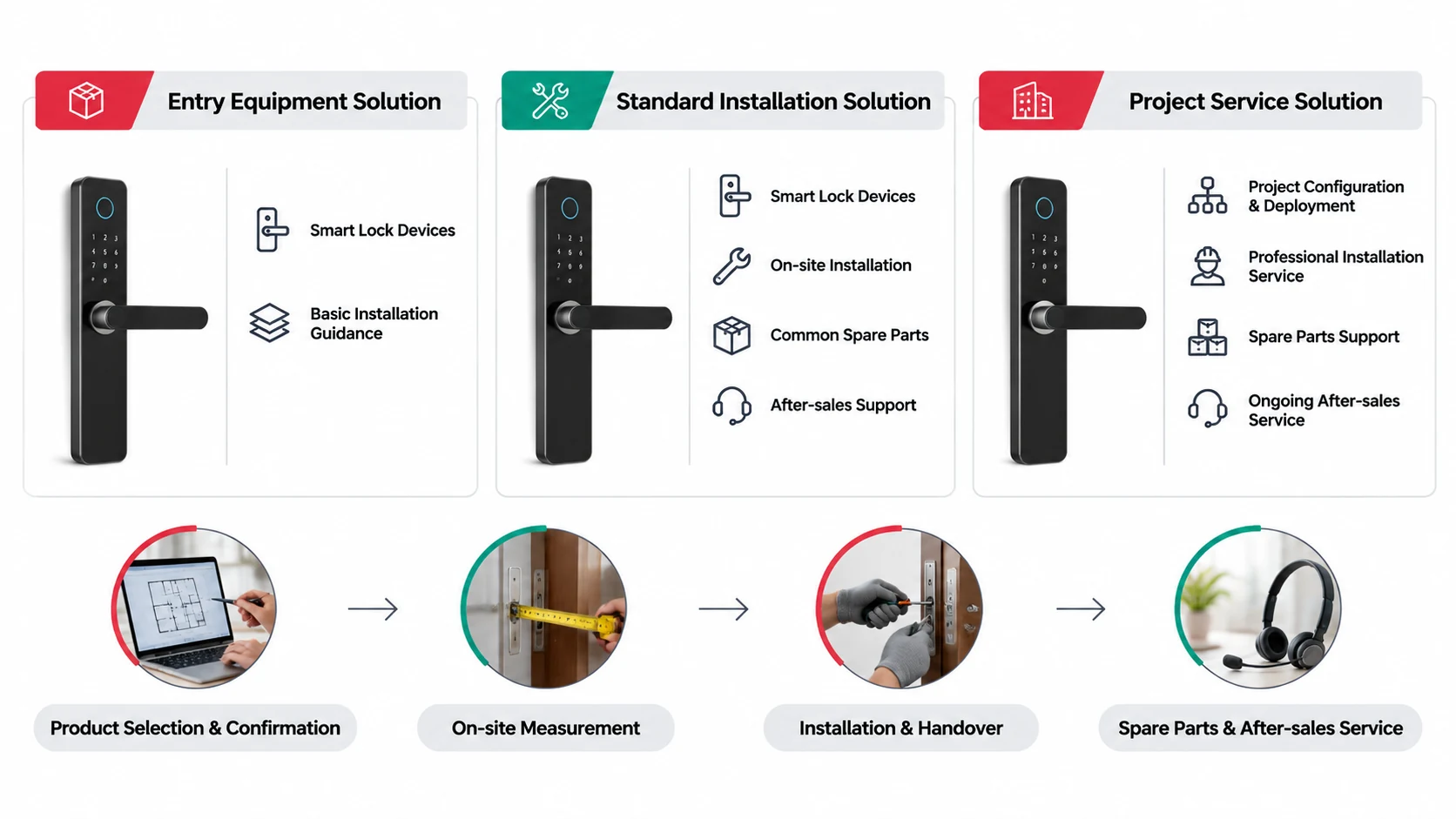
A useful portfolio does not have to contain many models. A dealer with limited working capital can define three buying paths and assign one or two verified options to each. Every option should be linked to the door types it is known to fit, the parts required, expected installation work, support terms and a spare-parts plan. If a specification or capability has not been checked, mark it as pending instead of asking a salesperson to fill the gap with an assumption.
The first path is a basic access option for price-sensitive buyers. Explain validated door conditions, box contents, whether standard installation is extra and how a manufacturer-provided emergency method is handed over. “Basic” does not mean “fits every door,” and low purchase cost does not prove lower lifetime cost. If the lock body, door thickness, handing or frame falls outside the confirmed range, inspect before quoting.
The second path is a mainstream option designed to reduce installation and daily-use friction. It need not be the most feature-rich product. It should have usable fit information for common local doors, a predictable installation process and support material that the dealer can explain. If a function depends on an app, internet connection, a hub, a subscription or an additional accessory, show that dependency separately. Do not imply that different products or ecosystems work together unless the exact combination has been tested or documented.
The third path is a defined project or service package for use cases such as multiple rental units or a small commercial property. Separate the device, survey, installation, administrator handover, consumables and ongoing support in the quote. If the buyer needs centralized management, an access-control connection or batch configuration, start with a pilot. Record the product versions, network conditions, user roles and exception process. A project package can carry a higher price when the price corresponds to verifiable work, not simply a vague “premium” label.
Each path needs a clear boundary: suitable customer, pre-installation checks, included service and extra charges. If two options differ only in finish or packaging, identify the customer benefit before keeping both.
Include installation and service costs in the quote
A usable margin calculation goes beyond the purchase and selling prices. Include acquisition or marketplace fees, freight, the survey, standard installation labor, non-standard work, the probability of a second visit, customer instruction, spare-parts carrying cost, returns and warranty handling time. Use the dealer’s own records where available. Label unknown values as assumptions and replace them with observed figures after several weeks of tracking. This makes it possible to see whether an entry-price model is attracting new buyers or quietly consuming labor that the hardware margin cannot cover.
Pre-installation screening should be part of the offer. Collect door thickness, opening direction, material, lock-body and handle photos, frame condition, and any power or network details required by the proposed setup. Explain that photos do not replace an on-site measurement. If the installer finds an incompatible door, damaged frame or holes needing repair, define a pause, revised quote and approval process. Drilling or structural changes require authorization and clear responsibility.
Describe service in four fields: included, conditions, exclusions and response. State whether a standard installation and handover are included, what door, power or network conditions apply, and whether door repair, wiring or third-party equipment are excluded. Explain how to report an issue, what information is needed, business hours and the time to the first update. Promise only a response level the team can sustain, and clarify how dealer visits, replacements, the supplier warranty and labor fees relate.
Design spare parts and support around the fault path
Spare-parts planning should begin with impact and replenishment time, not an instinct to stock everything. Record which components can prevent the door from operating and which affect only an additional feature. Ask the supplier whether a component can be replaced separately, how the correct model or batch is identified, how long replenishment takes and what the return terms are. A high-volume region may justify a small stock of confirmed wear parts or replacement units. A low-volume part may be better handled through a documented order and interim plan. Track the compatible product version, quantity, reorder point and owner in the inventory record. Do not mix untraceable or obsolete parts into stock intended for installation.
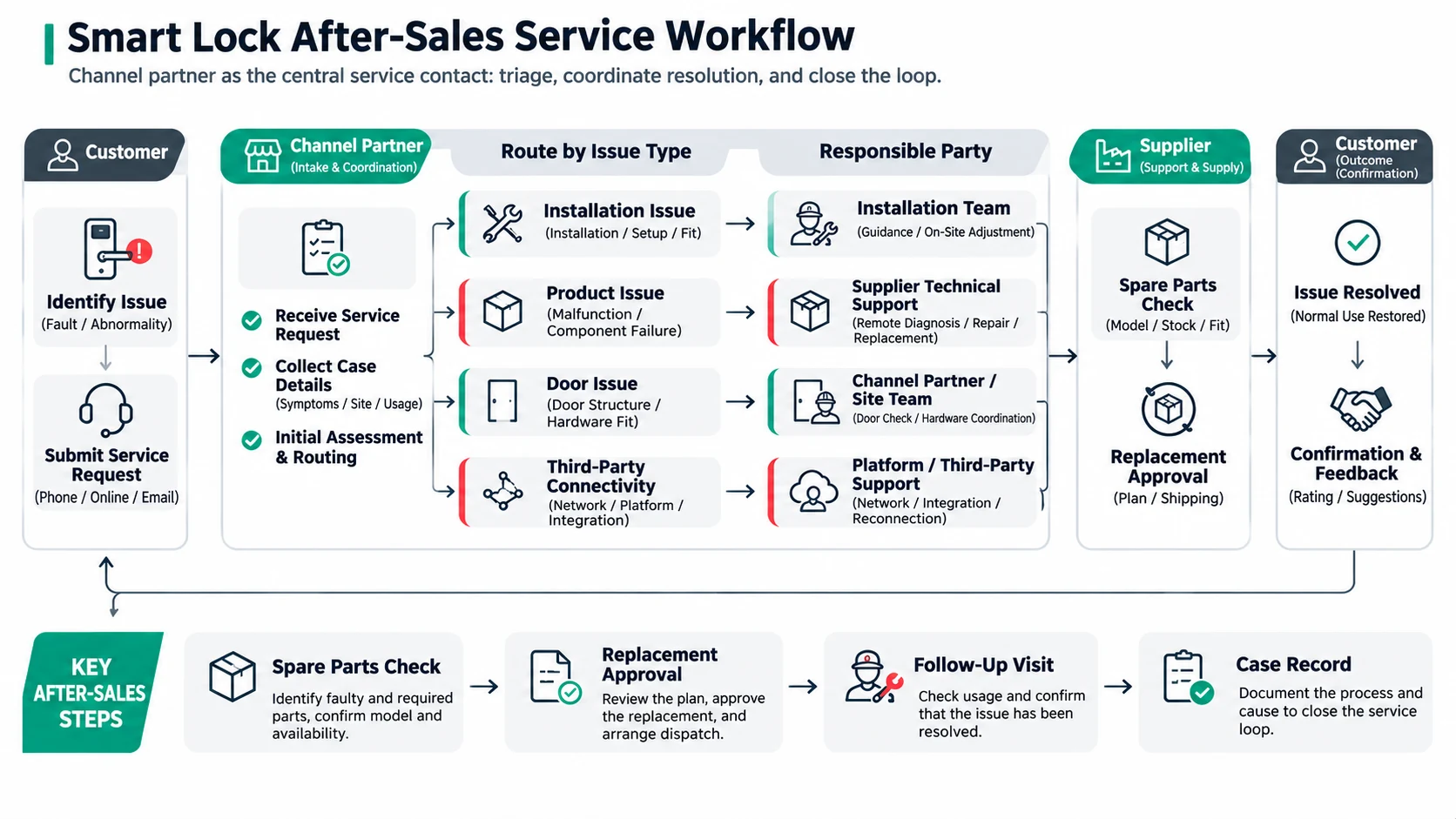
When a customer reports a fault, the dealer needs at least the model and serial details, purchase and installation dates, symptoms, whether the door can still be used, any recent site changes and actions already tried. If the complaint involves a door that cannot be opened or a person locked out, explain ahead of time what emergency service the dealer can actually provide and which local alternatives may be necessary. Do not promise that every lockout can be solved remotely. After initial checks, classify the case as a product issue, installation issue, usage question, door problem or third-party connection issue. Assign an owner and tell the customer what happens next. If the cause is still unknown, say that it is being investigated rather than assigning blame prematurely.
A responsibility matrix can clarify roles. The dealer checks requirements, gathers door information, performs contracted installation and handles first-line communication. The supplier provides documentation, its committed warranty and traceable parts support. The customer supplies accurate site information, approves extra work and completes administrator handover. A project may also need one customer-facing support desk and a decision on who authorizes replacements and pays repeat-visit costs. The contract and applicable consumer-protection law govern; an internal matrix cannot remove statutory rights.
Hypothetical example: test service capacity before expanding the low-cost line
The following example is fictional and illustrates a method only. It is not a real customer, an average market result or evidence of WAFU product performance. Suppose a regional dealer gets 40 residential enquiries monthly: 18 focus on the lowest hardware price, 12 on installation and 10 on small rental properties. Its previous-month records show 1.4 average installation hours for entry-price jobs, with about one quarter requiring a second visit for a door issue. These figures belong only to the hypothetical shop.
Rather than buying a large quantity immediately, the owner limits one entry option to common door types already checked and quotes standard installation within a stated scope. A mainstream offer combines a survey, installation, user handover and a first-line support contact. Rental enquiries are treated as pilots until administrator roles and spare-parts needs are understood. For six weeks, the shop records conversion by path, total labor per job, reasons for a second visit, returns and service revenue. If the entry option brings enquiries but repeat-visit costs persistently exceed its margin, the dealer narrows the fit range or prices the extra work separately. If the mainstream package has a higher first-time completion rate, the dealer can consider expanding its stock. The decision comes from this shop’s measured results, not from turning a national low-price share into a purchase order.
Review five measures each month
Track conversion, first-time installation completion, service hours per order, after-sales case rate and resolution time for each path. Revenue can rise while labor and repeat visits rise with it. A slower model may still help deliver common jobs. Classify lost sales by price, door fit, scope, confidence or response time rather than labeling every loss “price too high.”
As low-cost locks become more common, a distributor’s decision is not simply whether to match the cheapest listing. It is which customers, site work and support risks the business is prepared to serve. Start with a narrow verified fit range, put installation, parts and responsibility into the quote, then adjust stock using sales and service data. That turns the portfolio into an operating plan rather than a price sheet.
CTA: Need to map a distributor assortment to local door types, installation capacity and support coverage? Contact the team to discuss a review checklist covering product fit, delivery scope and responsibility boundaries.
Sources
- China Appliance Network, Jia Qiong, “Volume and value fall as sub-RMB 1,000 locks approach 80%: How far can low-price competition go?”, 23 Nov 2026. The article attributes the first-nine-month online figures to AVC and Q3 channel and price figures to RUNTO: source.
- China Appliance Network, “Where can smart locks differentiate after features converge?”, 9 Nov 2026, credited to AVC and specifying traditional and content e-commerce in its online scope: source.
- PChome, “China smart-lock all-channel sales fell 9.4% in Q3; Xiaomi led online unit share,” 5 Nov 2026, used to cross-check RUNTO figures and channel context: source.
Data note: AVC’s cited values cover China’s online market during Q1–Q3 2026 and include traditional e-commerce and content commerce. RUNTO’s unit and value totals cover Q3 2026 across online and offline channels; the below-RMB-1,000 and RMB 0–499 shares refer to RUNTO’s online price mix for Q3. The sources use different periods, scopes and methods, so this article does not combine them as one series.
Discuss your project
Share your project requirements, target market and questions with our team.