This article is intended for technical communication during procurement and project-launch stages. It is not legal advice or a certification conclusion. The suitability of a specific product, applicable standards and test plans should be confirmed in sequence according to the target market, wireless and network functions, data-processing methods, and the opinion of the relevant certification body.
EU buyers no longer review only a CE mark or a wireless test report before placing a smart lock order. For products with internet, app, cloud or wireless communication functions, procurement teams need to place product architecture, network security, data processing, sample validation and mass-production changes on the same acceptance checklist. This guide provides a working framework that can be used directly for RFQs, sample reviews and OEM/ODM project proposals.
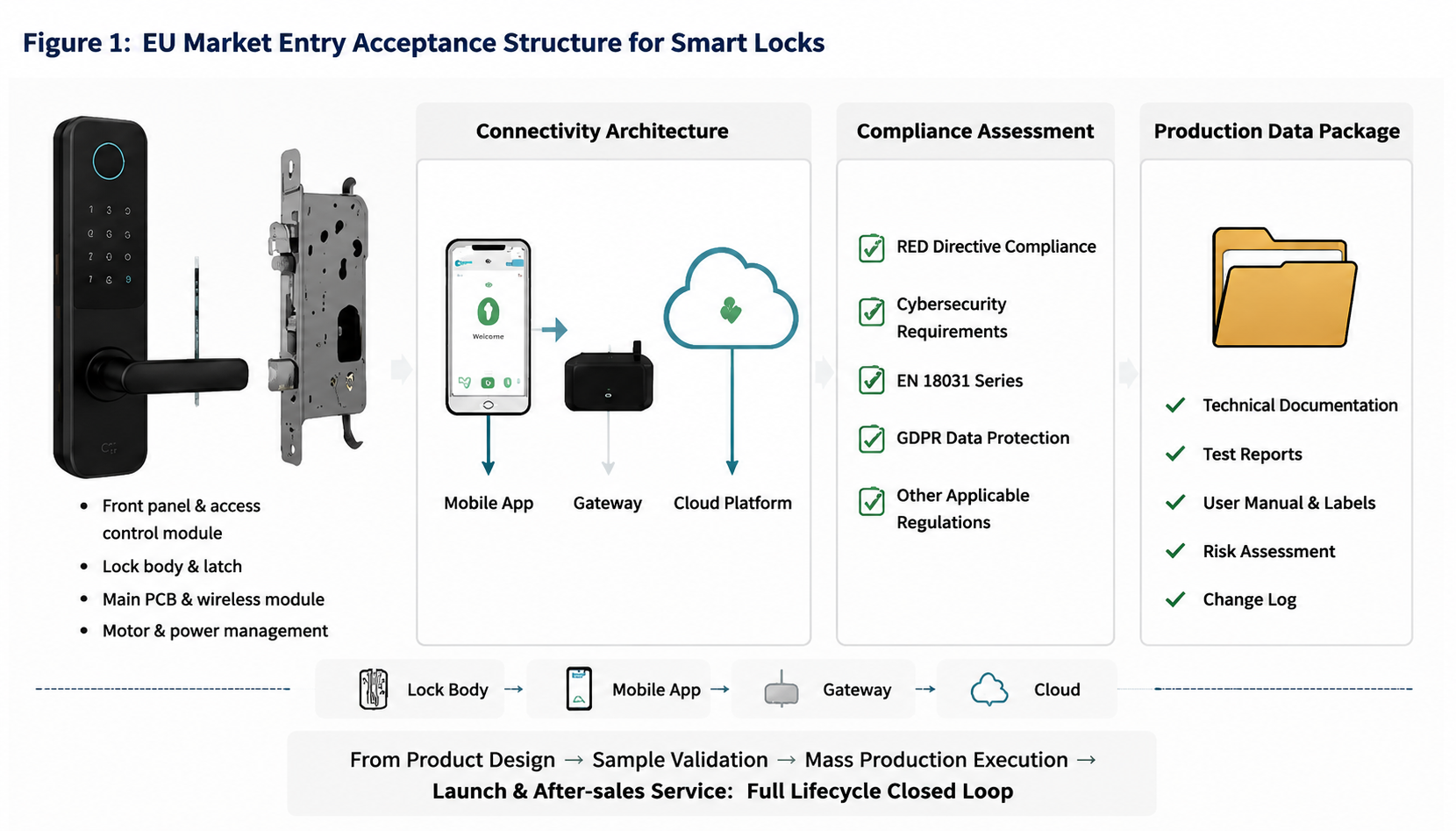
Start by Breaking Acceptance Objects Down with a Structure Diagram
When procuring a smart lock for the EU market, first break the complete product down into acceptance objects: front panel, lock body and bolt, main control board, wireless module, motor and gearbox, mobile app, gateway, cloud interface, in-box documentation and mass-production version. This does not replace laboratory testing. It enables the buyer to identify, at the inquiry stage, which materials the supplier must provide and which questions must be confirmed jointly by the brand, importer or app/cloud service provider.
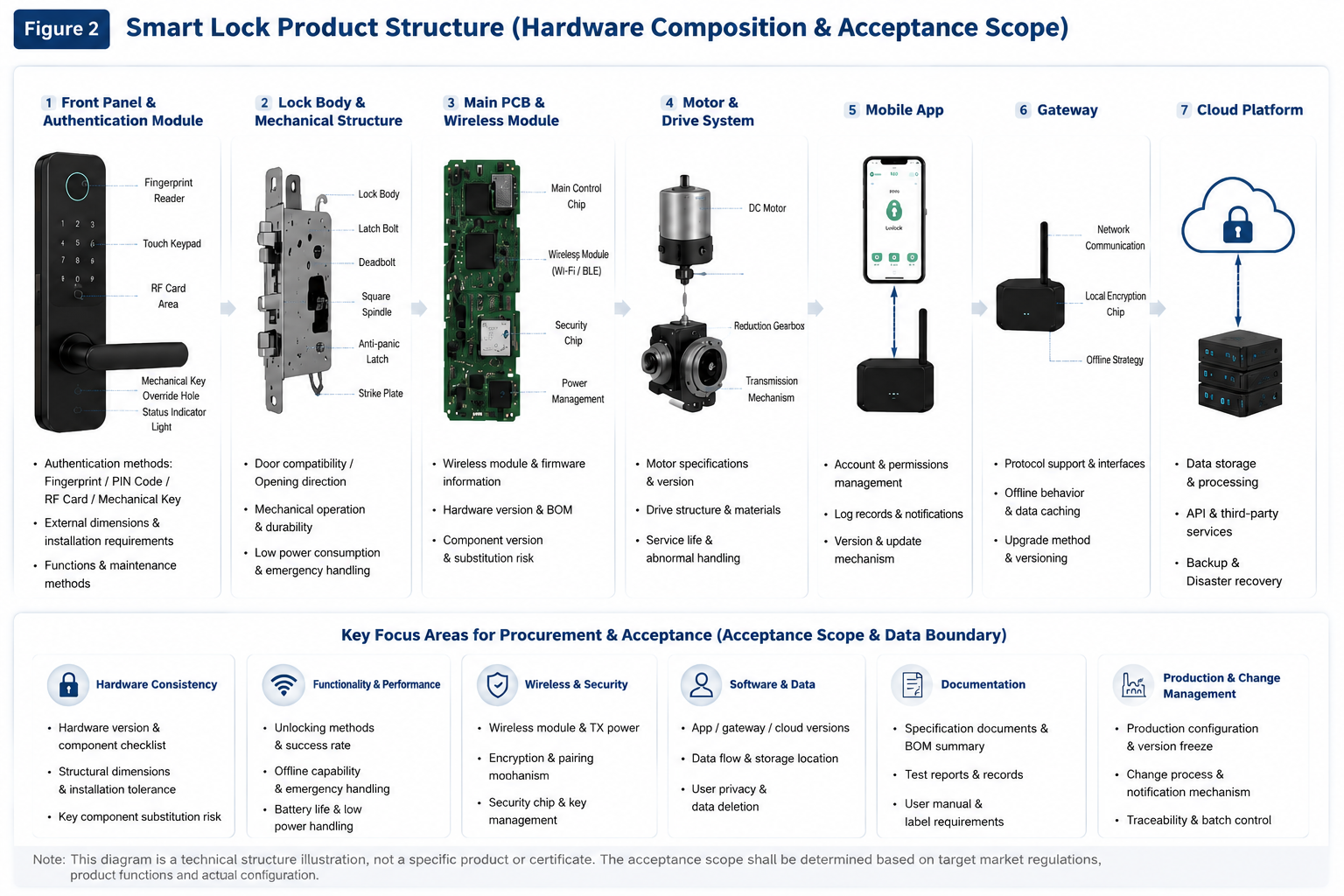
| Structure object | Key procurement acceptance points | Supplier information required |
|---|---|---|
| Front panel and access methods | Do fingerprint, PIN, card, mechanical-key and emergency-access methods match the target-market positioning? | Functional specification, installation dimensions, appearance version, instructions and maintenance method |
| Lock body, bolt and motor | Door-type compatibility, handing, mechanical operation, low-battery and offline emergency behaviour | Lock-body dimensions, key-component versions, sample test records and exception-handling process |
| Main board and wireless module | Wireless method, module version, pairing process, interference conditions and firmware dependency | Module information, firmware version, interface description, test records and change-notification mechanism |
| App, gateway and cloud | Account permissions, data flows, update mechanism, gateway offline behaviour and third-party service boundaries | Product architecture description, data-processing instructions, version list and vulnerability-response contact |
Define the Product and Regulatory Scope First
“Smart lock” is not a sufficiently specific classification for determining a compliance path. Buyers should first list the target SKU’s wireless module, internet connection, mobile-app or cloud-service functions, personal-data processing and any payment or credential functions. Local wireless control, remote account systems, biometric identification and cloud data synchronisation can each lead to different risk assessments and documentation requirements.
Cybersecurity requirements under the EU Radio Equipment Directive (RED) arise from Commission Delegated Regulation (EU) 2022/30. The Regulation has applied to the relevant equipment categories since 1 August 2025. Its applicability should be confirmed case by case by the certification body according to product functions, wireless configurations and data-processing methods. For connected radio equipment, buyers should not interpret the use of a certified module as proof that the complete product automatically meets every requirement. The product software, interfaces, accounts, update methods and actual use scenarios all need project-level confirmation.
| Product form | What should be confirmed first when the project is set up? | What should not be missing from the procurement package? |
|---|---|---|
| Local wireless remote-control or Bluetooth lock | Wireless method, control distance, whether a phone configures the network and whether an administration account exists | Hardware version, wireless-module information, pairing and factory-reset process, on-site interference-test conditions |
| App- or gateway-enabled smart lock | Versions and interfaces of the app, gateway and lock body; behaviour when connectivity is lost | Account permissions, gateway offline behaviour, upgrade method, logs and after-sales boundaries |
| Cloud-connected lock or lock integrated with a third-party platform | Data flows, service providers, APIs, regional deployment and account lifecycle | Data-processing allocation, interface-change records, vulnerability-reporting channels, and data and lock status after service termination |
This table is not a regulatory classification conclusion. It is an early-review tool that helps avoid purchasing “a lock with an app” as if it were ordinary hardware. Where an answer is unclear, mark it for confirmation before quotation instead of replacing the project decision with a sales commitment.
Information Required at the Project Inquiry Stage
The more complete the initial information, the better a supplier can propose workable sample and quotation paths. The first technical communication should include at least:
- Markets and channels: intended EU sales countries, first-batch and annual volumes, and the division of responsibility between the brand and importer.
- Lock and door types: lock type, door material, installation dimensions, handing, emergency-access plan and required unlocking methods.
- Connectivity architecture: Bluetooth, Wi-Fi, 433 MHz or other wireless methods; and whether a gateway, app, cloud or third-party platform is involved.
- Data and accounts: whether accounts, unlock logs, location, biometric data or device identifiers are collected; who holds the data; and the required retention and deletion rules.
- Sample and delivery plan: sample quantity, estimated delivery schedule, acceptance criteria, packaging and instruction languages, and after-sales expectations.
How to Assess RED Cybersecurity and EN 18031
RED cybersecurity assessment should begin with the actual product architecture, not with a standard name. The procurement team should map radio functions, network connectivity, accounts, data flows, update paths and fraud-relevant functions, then confirm the applicable requirements and assessment route with the responsible compliance party. The EN 18031 series may be relevant for particular product functions, but the specific applicable part and evaluation method must be determined for the actual configuration.
For RFQs, use questions that can be checked later: which firmware version is evaluated; how are security updates delivered; who can create, remove or recover accounts; which data is stored locally or in the cloud; how are vulnerabilities reported; and what happens if the gateway, app or cloud service is unavailable? Clear answers turn a general “cybersecurity” claim into a reviewable project record.
Sample Acceptance: Turn Functions into Repeatable Checks
A sample should be identified as a specific configuration, rather than accepted simply because “the functions work.” Record the sample number, hardware version, firmware version, app or gateway version, test conditions, test results and open issues. This gives the parties a stable baseline for later production release and change control.
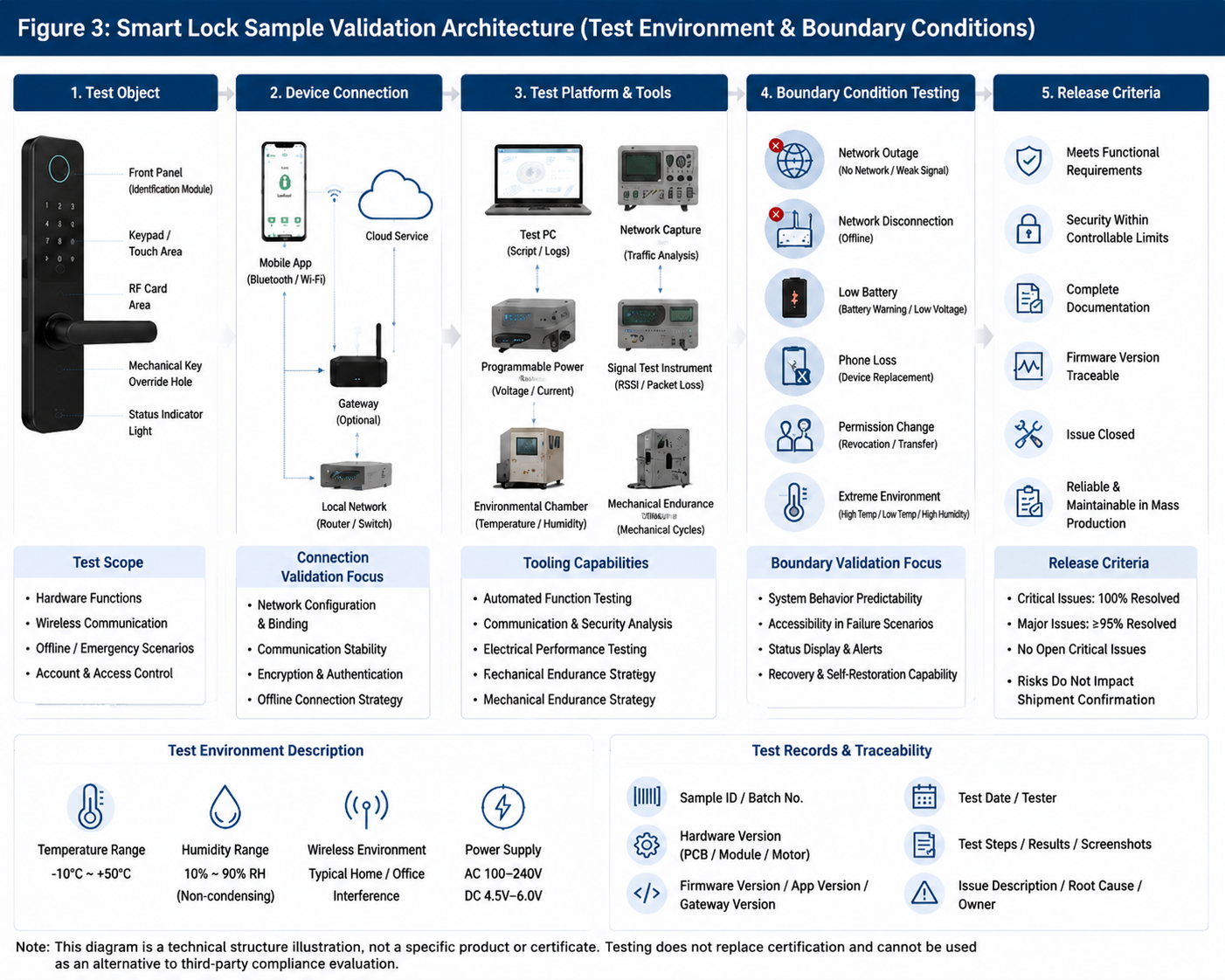
Testing is neither equivalent to certification nor a substitute for third-party assessment. Its value is that procurement, R&D, quality and after-sales teams can establish the same record of what they are expected to accept before mass production begins.
Mass-Production Release: Who Signs Off on What
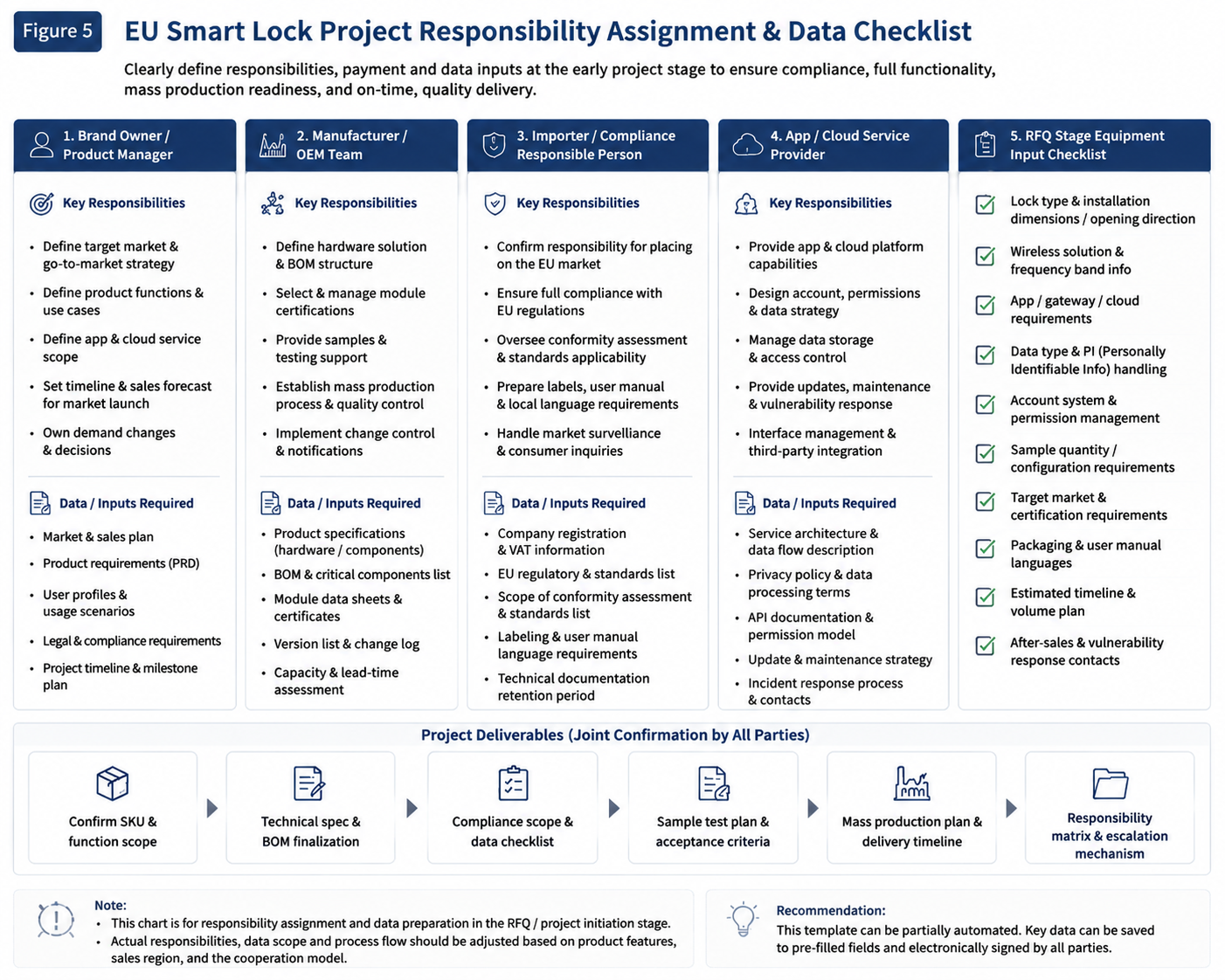
The key to mass-production release is not “the sample can be used”; it is confirmation that the production product is consistent with the validated sample. Before the first production batch, prepare a release record of no more than one page and have it reviewed jointly by the brand owner and the manufacturer responsible for conformity:
- Configuration freeze: list the versions of the lock body, wireless module, firmware, app, gateway and cloud interface.
- Closed sample loop: confirm that acceptance issues have been resolved, and identify the risks, owners and shipment-release basis for any open items.
- Consistent documentation: models, labels, instructions, packaging, test records and technical documents must refer to the same product version.
- After-sales readiness: establish clear contacts for upgrades, faults, accounts and vulnerability reports to avoid repeatedly passing end-user issues among brands, factories and service providers.
Technical Documentation and Mass-Production Change Control
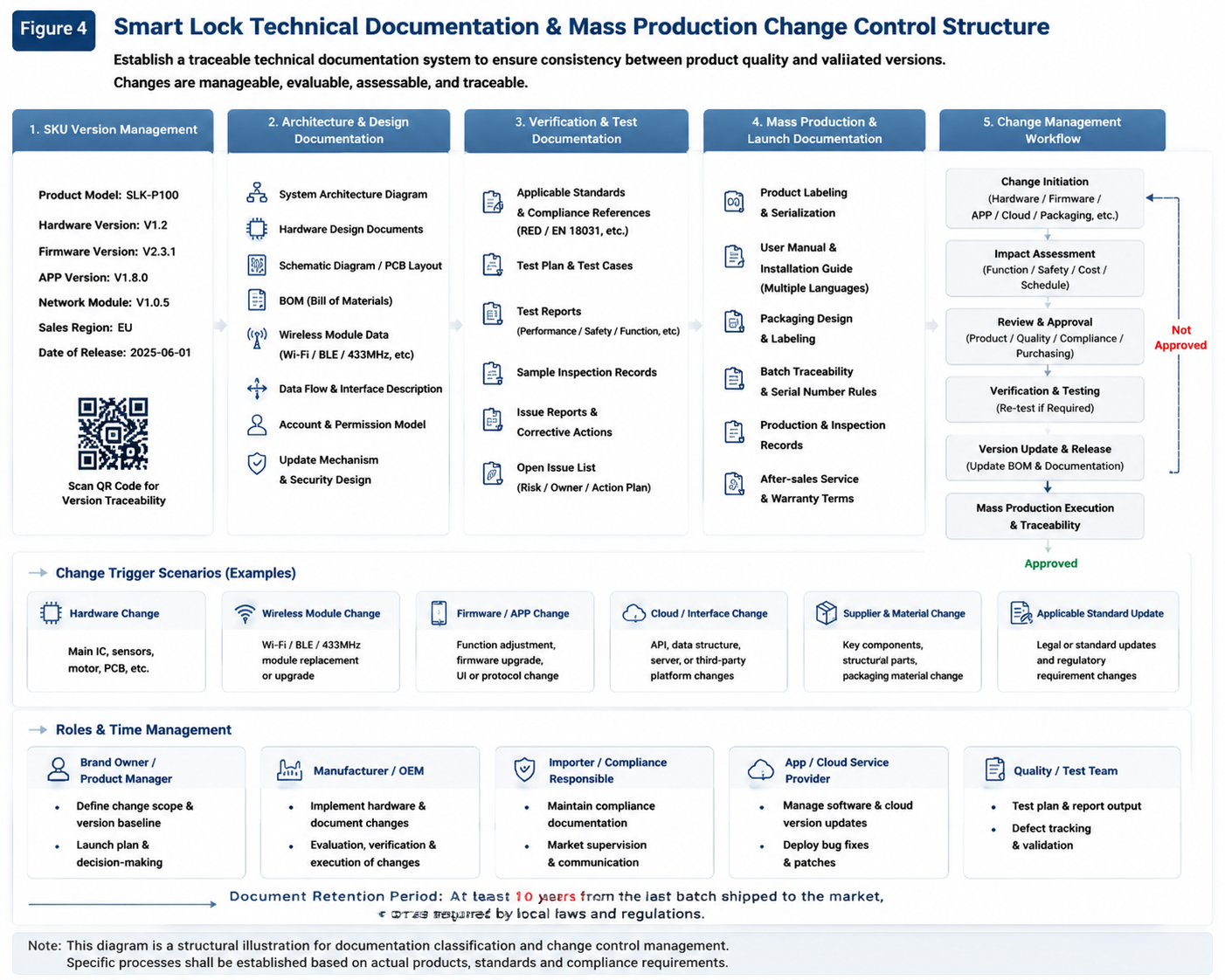
Compliance information must remain traceably linked to the product actually placed on the market. A change review should be triggered whenever the wireless module, firmware, app, cloud interface, service provider or packaging changes.
- Product identification: model, version, key components and sales territory.
- Architecture information: description of wireless functions, network, accounts, data flows and update mechanisms.
- Verification information: applicable-standard assessment, test plans, reports, sample-acceptance records and open issues.
- Mass-production data: labels, instructions, packaging, change records, batch traceability and after-sales contacts.
- Responsibilities and timing: brands, manufacturers, importers and service providers are each responsible for data maintenance, issue response and upgrade approval.
Rather than completing documents temporarily before shipment, a more effective approach is to put certification, quality and software versions under the same set of change thresholds when the project is created. For procurement teams searching for “EU smart lock compliance”, “smart lock export to EU”, “RED cybersecurity smart lock” or “EN 18031 smart lock”, the most valuable supplier response is not a generic quotation. It is a project proposal that explains the sample version, product architecture, data responsibilities and limits for mass-production changes.
The following articles may also be useful: for a basic review of export certification, see “Smart Lock CE, FCC and EN Standard Procurement Practices”; for wireless-solution selection, see “Smart Lock Wireless Protocol Comparison Guide”. If the procurement team also needs to evaluate manufacturing capability and long-term supply risks, refer to “Smart Lock Factory Technical Evaluation Guide” and “Invisible Lock ODM System Development Guide”.
EU Smart Lock Procurement FAQ
Is certification of the wireless module sufficient for exporting a smart lock to the EU?
Usually not. Wireless-module documentation is an important input to the assessment of the complete product, but the lock’s actual sales configuration, firmware, app, gateway, cloud interface and account permissions may affect whole-product conformity and network-security assessment under the Radio Equipment Directive (RED).
Does EN 18031 apply to every smart lock with an app?
No standard name should be applied to every model automatically. Procurement teams should first confirm whether the product falls within the relevant RED cybersecurity requirements, then determine the applicable parts of the EN 18031 series and how they should be applied according to its radio, network, data-processing and anti-fraud functions.
What information should be reviewed during EU smart lock sample acceptance?
Review the sample identifier, hardware and firmware versions, app or gateway version, wireless and offline behaviour, account permissions, update mechanism, labels, instructions, packaging version, test records and mass-production change-control process together.
What role does a smart lock structure diagram play in an EU project inquiry?
The structure diagram helps the buyer divide the front panel, lock body, main control board, wireless module, motor, app, gateway and cloud boundary into reviewable objects. It therefore clarifies which elements need coverage in sample validation, technical documentation and mass-production change records.
What should be stated in an EU project inquiry to a smart lock factory?
State the destination country, lock and door type, wireless method, whether an app or cloud is required, data and account requirements, sample quantity, estimated delivery schedule, packaging and instruction language, and the division of responsibilities among the brand, importer and service providers.
Request a Compliance Review and Project Quotation
Please tell WAFU the destination country, lock type, wireless method, whether an app or cloud is required, estimated delivery schedule and sample quantity. We can help define the product configuration, sample-validation path and OEM/ODM scope accordingly. The applicability of certification and the final test plan remain subject to the target product and the opinion of qualified professional bodies.
The figures cited in this article are presented as textual illustrations because of formatting constraints.