A practical interface matrix for coordinating door hardware, lock suppliers, access platforms, network teams, installers, integrators, and project owners.
1. Decision Boundary
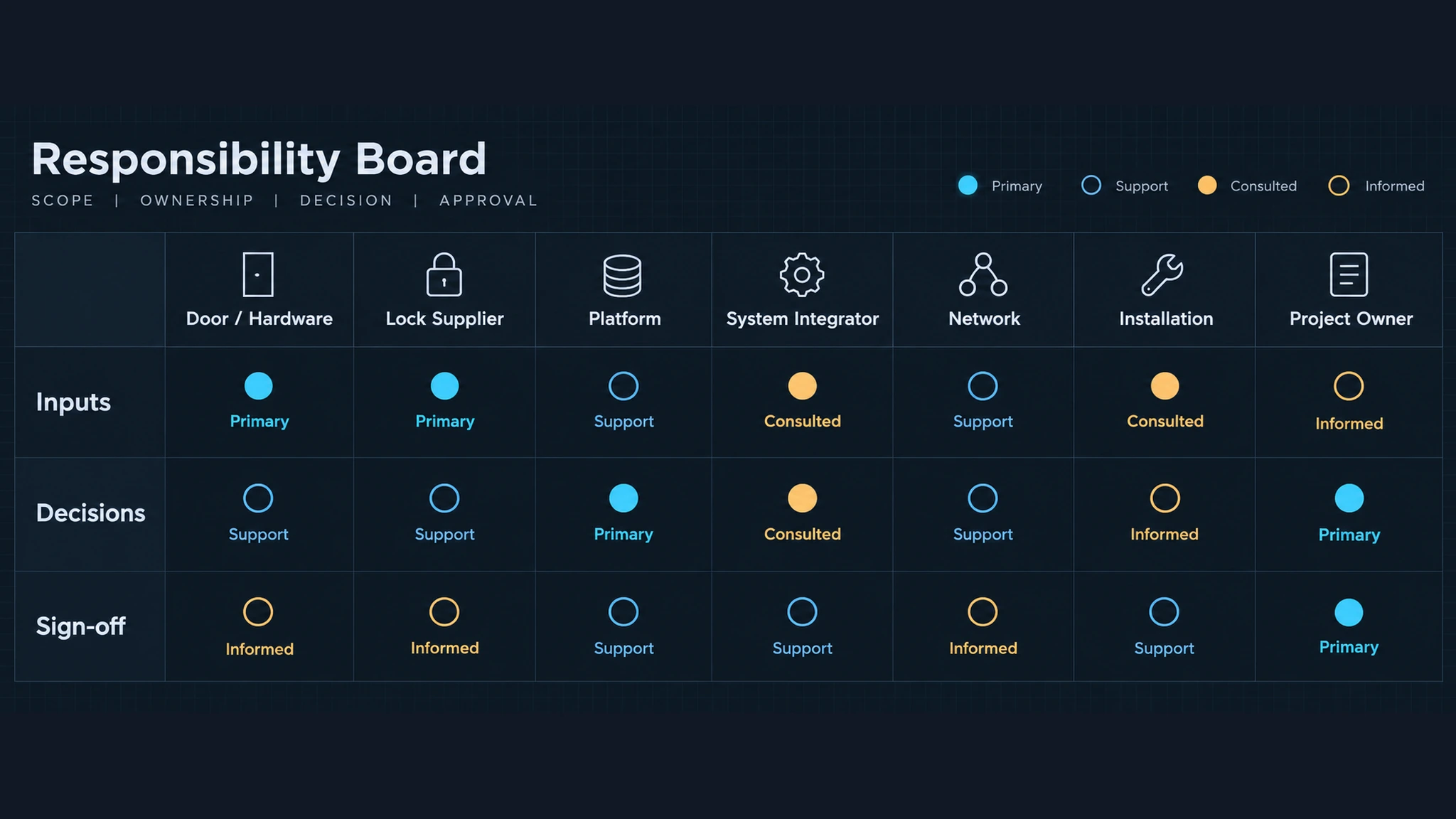
A smart lock project can fail at an interface even when each individual party believes its own work is complete. This article defines the boundary of an interface review: which party provides information, which party receives it, what must be acknowledged, and who investigates a failure.
The scope covers the door hardware party, lock supplier, access platform party, system integrator, network or operations party, installer, and project owner. A hotel or apartment project may provide the collaboration context, but the matrix does not describe a hotel solution or a residential solution.
Do not use the matrix to infer product capability, certification, compatibility, delivery performance, or project success. Those matters require their own evidence. The matrix records interfaces and ownership only.
2. Project Parties
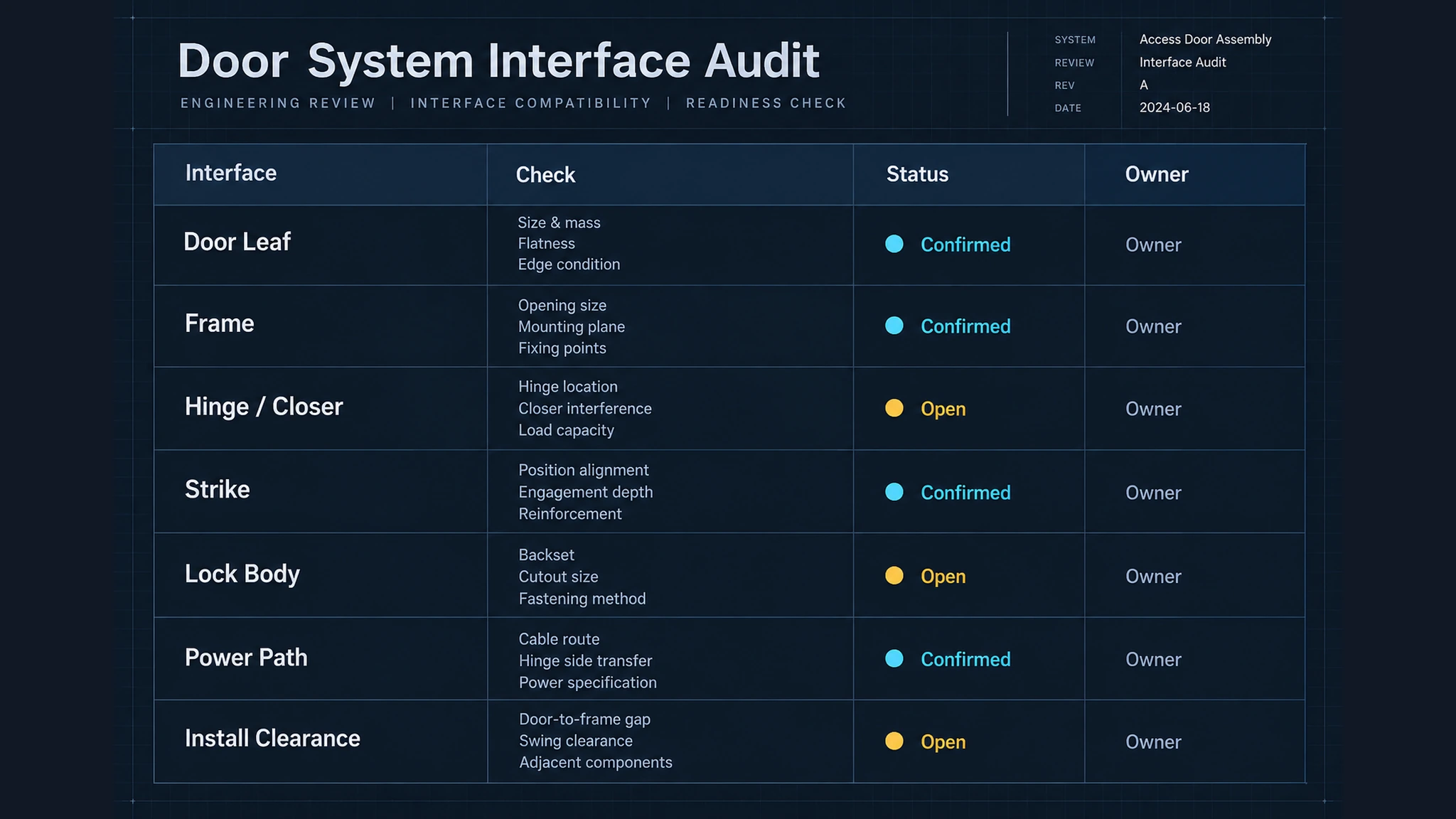
Start with named parties rather than job titles alone. For each interface, record the organization, named contact, decision authority, information supplied, expected response, and escalation route.
The door hardware party confirms door, frame, preparation, and mechanical constraints. The lock supplier confirms the information needed to identify the supplied lock configuration. The access platform party defines the data and operational boundary of its platform. The system integrator coordinates dependencies between systems. The network or operations party defines connectivity and operating controls. The installer confirms what was physically installed. The project owner accepts the agreed information and assigns unresolved decisions.
One organization may perform more than one role, but the roles should remain separate in the record. A missing role is an interface risk, not an assumption that another party will absorb the work.
3. Door Hardware Interface
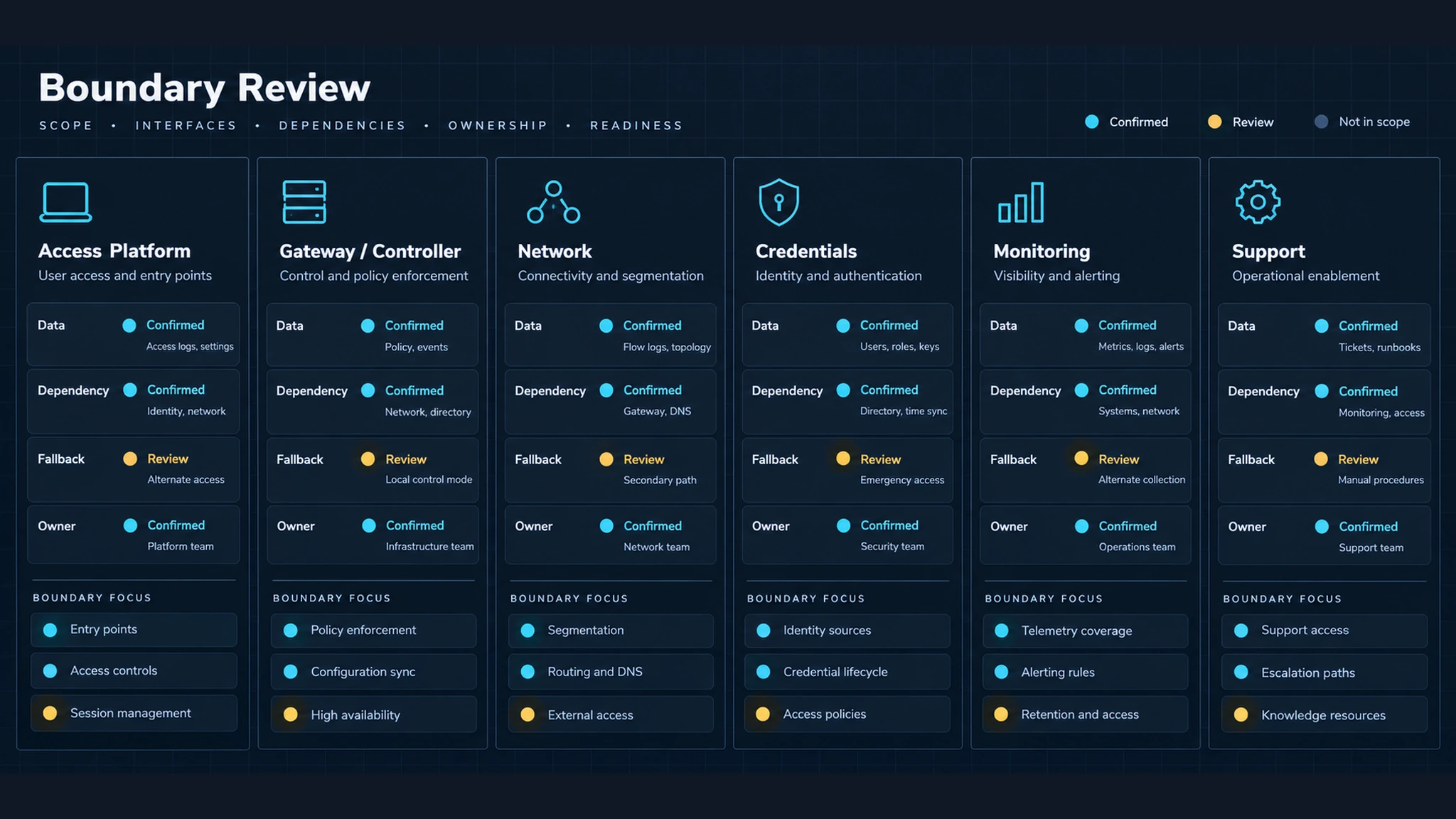
The door hardware interface connects the opening information to the lock installation information. Record the door identifier, opening type, frame condition, preparation drawing or reference, mechanical restrictions, power route, and any information the installer must receive before work starts.
The door hardware party should identify what is confirmed and what is still field-dependent. The lock supplier should identify the lock-side information it needs, without treating a general model description as a door-specific approval. The installer should return an installation record that identifies deviations or missing conditions.
When an issue is discovered, the first question is whether it concerns the opening, the lock configuration, the installation activity, or an unrecorded assumption. This classification helps route the issue to the correct party.
4. Access Platform Interface
The access platform interface defines the information exchanged between the lock-related equipment, the platform party, and the system integrator. Record identifiers, event or status data, command ownership, account or permission assumptions, supported operating conditions, and the evidence required to confirm that an exchange was received.
Avoid treating a platform reference as proof that every lock, version, or configuration is supported. The interface record should state what has been defined, what is supplied by another party, and what remains open. The integrator should maintain the mapping between project identifiers and the systems that use them.
If a command or event is missing, the investigation should first establish whether it was generated, transmitted, received, interpreted, or displayed. These stages may belong to different parties.
5. Network Operations Interface
The network and operations interface describes the conditions under which information can move and be monitored. Record connection ownership, addressing or access prerequisites, security contacts, monitoring responsibility, maintenance windows, offline expectations, and the route for reporting an operational fault.
The network party should not be assigned responsibility for a device-side issue merely because the device uses a network. Likewise, a device or platform party should not assume network availability without a recorded prerequisite. Each prerequisite needs an owner, a confirmation method, and a point at which the project can escalate.
For a reported failure, distinguish loss of power, local device behavior, network transport, platform processing, and user-facing display. This creates a shared fault vocabulary across teams.
6. Pilot Handover
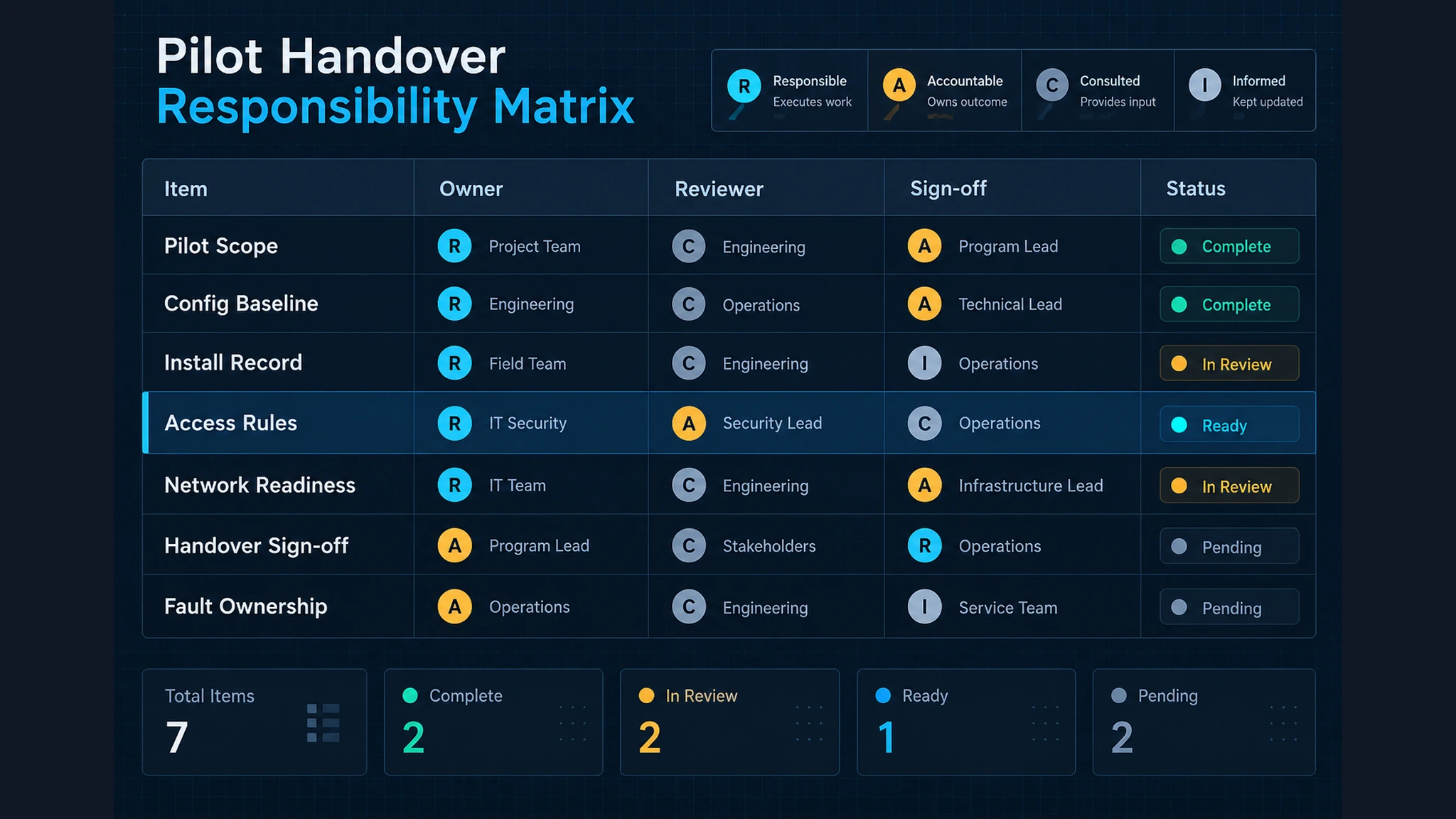
Pilot handover is an information handover, not a claim that every project condition has been proven. Define the pilot scope, participating parties, records to be exchanged, unresolved items, observation period, and acceptance authority.
The handover record should include the installed identifier, relevant configuration reference, interface contacts, known limitations, open questions, and the next action for each open item. The installer, integrator, platform party, network party, supplier, and project owner should acknowledge the portions relevant to them.
If a fault appears during the pilot, record the observed symptom, time, location or identifier, last known change, evidence collected, temporary action, and assigned investigation owner. Do not assign final responsibility from the symptom alone.
7. Responsibility Matrix
Use one row per interface or handover item. “R” means responsible for completing the item, “A” means accountable for the decision or acceptance, “C” means consulted, and “I” means informed.
| Interface item | Door hardware | Lock supplier | Platform party | Integrator | Network/operations | Installer | Project owner |
|---|---|---|---|---|---|---|---|
| Opening and preparation information | R/A | C | I | C | I | C | A |
| Lock configuration reference | C | R | C | A | I | C | I |
| Platform data mapping | I | C | R | A | C | I | I |
| Connectivity prerequisites | I | C | C | A | R | I | I |
| Installation deviation record | C | C | I | A | I | R | I |
| Pilot interface observation | C | C | C | R | C | C | A |
| Fault triage and escalation | C | C | C | R | C | C | A |
| Handover record and open items | C | C | C | R | C | C | A |
The matrix is a coordination record, not a substitute for contracts or technical evidence. Update it when a party, interface, contact, or decision authority changes.
8. Conclusion
A project interface matrix makes invisible dependencies visible. It connects each handover item to a named party, expected information, acknowledgment, and fault route. This is useful in multi-party hotel or apartment projects without turning the article into a solution guide for either sector.
Contact us
Share the project party list, interface questions, handover records, and known fault scenarios to build a responsibility matrix for the defined project.