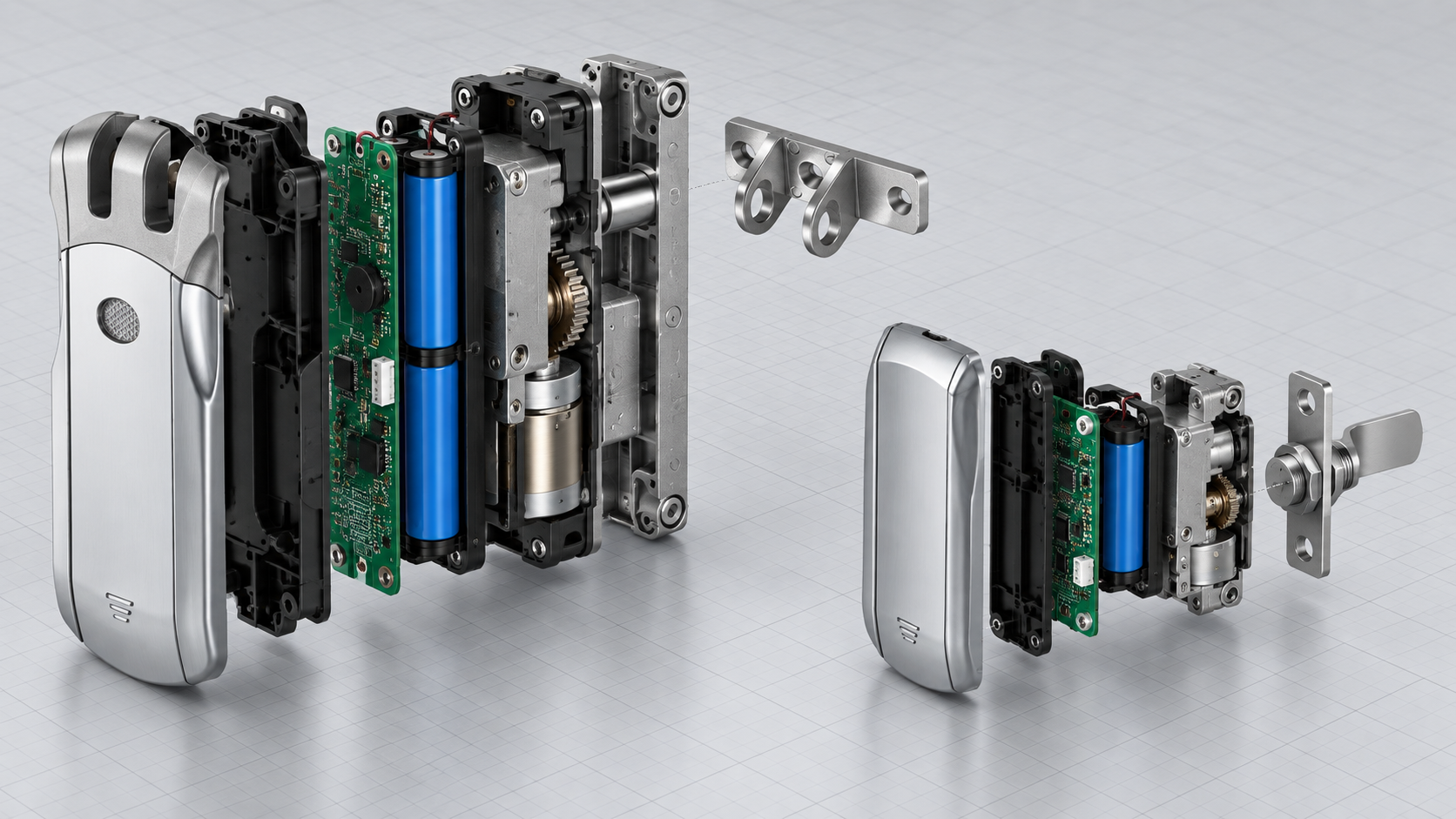
This is a feasibility study, not a product release. WAFU does not currently present WF-010 or WF-019 as standard cabinet locks. Final suitability requires drawings, a purpose-built sample and written specifications.
WF-010 and WF-019 already combine concealed installation, battery power, RF control and a motorized mechanism. Those capabilities create a useful engineering starting point, but a cabinet door changes the mechanical envelope, latch geometry, service access and radio environment. The correct question is not whether the existing door lock can simply be screwed onto a cabinet; it is which modules can be reused and which must be redesigned.
1. Define the decision boundary before discussing a model
A door lock is designed around a door leaf, frame and strike relationship. A cabinet lock may work with a thin sheet-metal panel, a rotating cam, a short linear bolt or a latch that must fit behind shelves and internal equipment. The same word “concealed” therefore describes very different mechanical conditions.
Treat WF-010 and WF-019 as donor platforms for electronics, RF control and manufacturing knowledge. Do not treat their existing housing, strike or battery arrangement as approved cabinet hardware.
2. Compare the installation envelope and load path
Start with cabinet-panel thickness, internal clearance, frame return, hinge play, opening direction and the keeper location. A thin panel may require a reinforcing plate, while a double-wall cabinet may block access to mounting screws and emergency release.
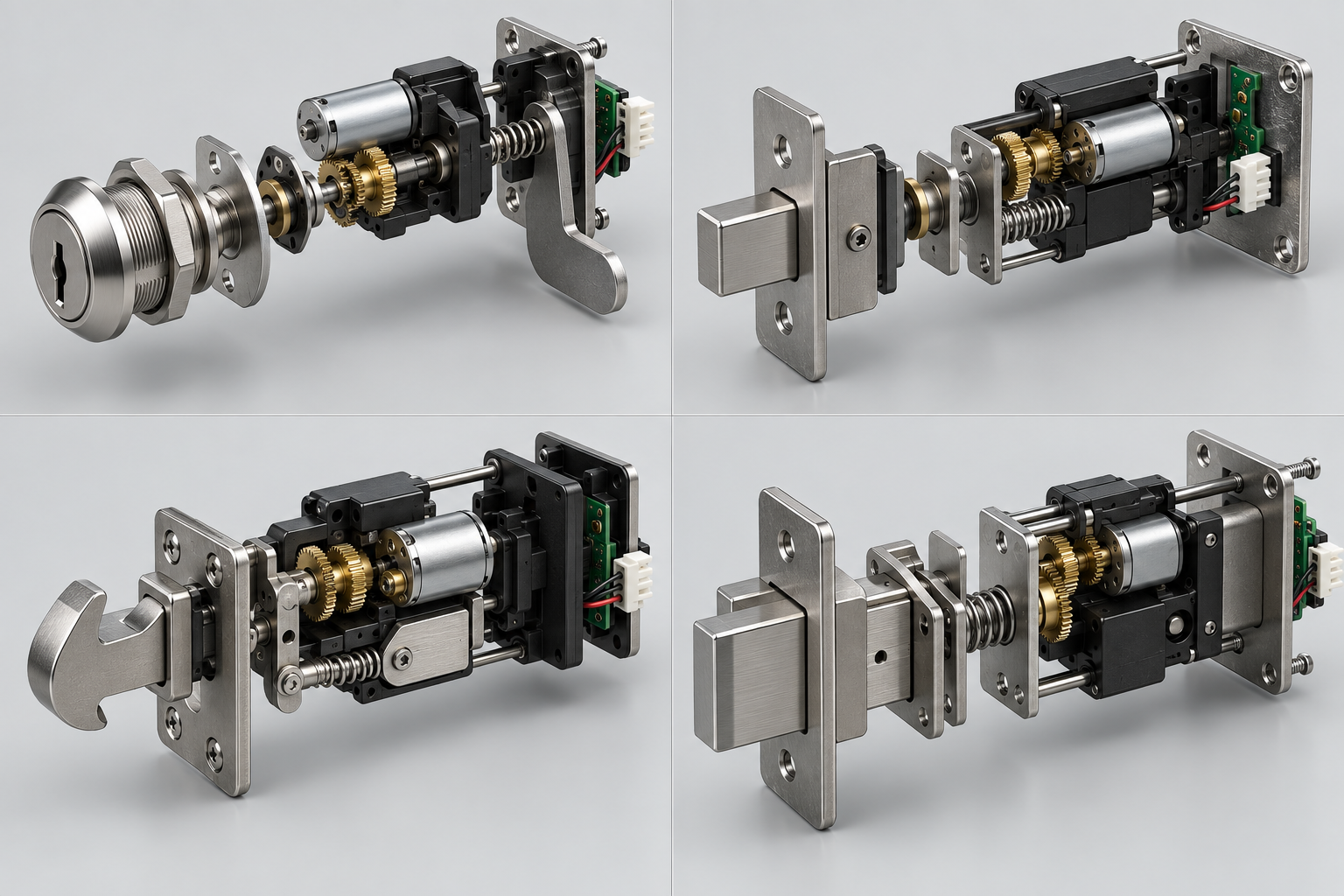
The load path also changes. A door lock often drives a bolt toward a fixed frame strike. A cabinet mechanism may rotate a cam behind a flange or move a short bolt through a compact keeper. Required travel, lever arm, backlash and resistance must be measured on the target cabinet.
3. Identify modules that may be reusable
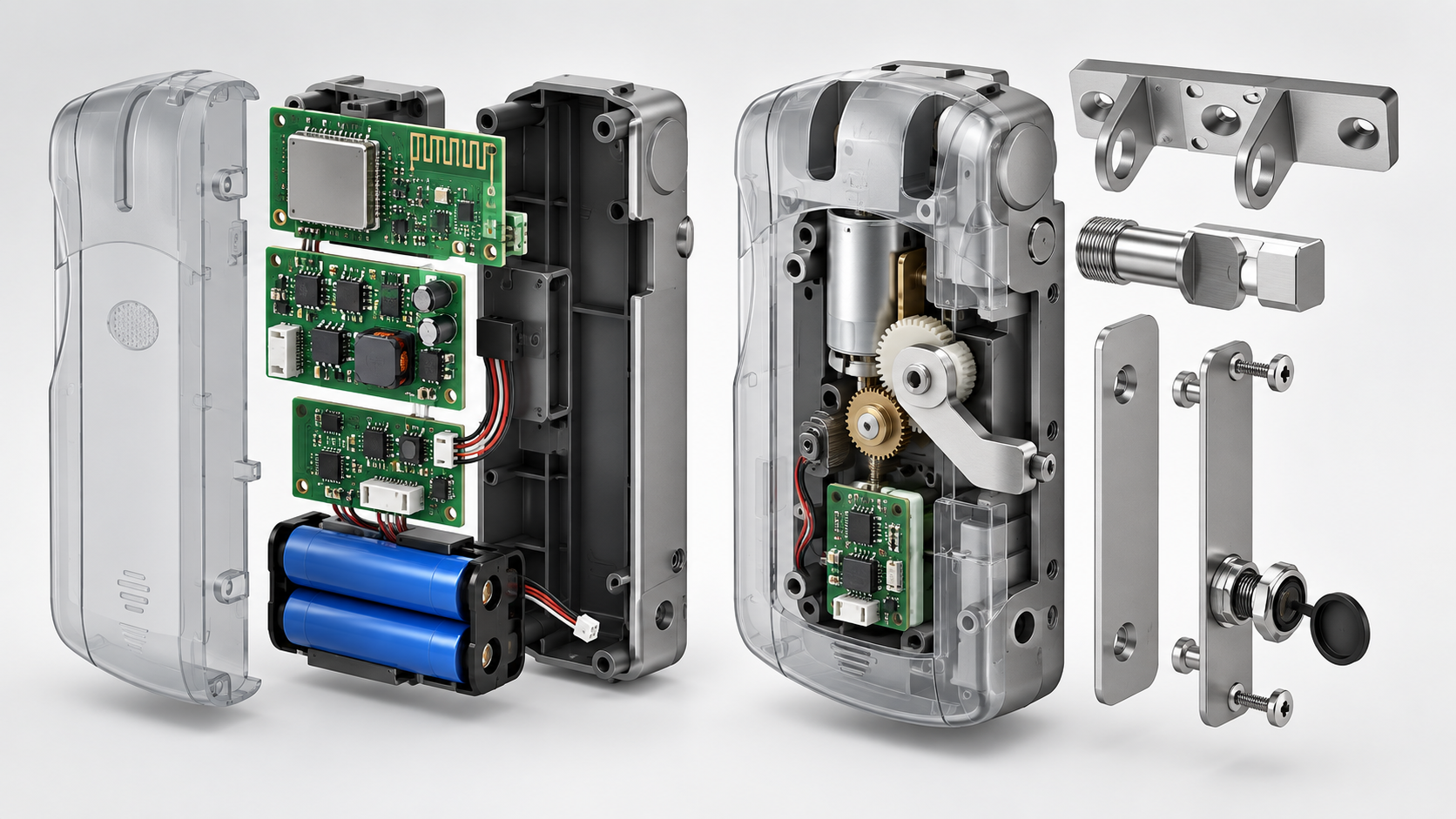
The most reusable assets are likely to be low-power RF experience, remote enrollment logic, motor-drive concepts, battery monitoring, warning logic and parts of the production test method. These are engineering capabilities, not proof that the existing PCB or firmware can be transferred unchanged.
A cabinet project should separately review controller size, antenna location, connector direction, motor current, sleep current, user authorization and the emergency-power strategy. A smaller enclosure can force a different PCB outline and different battery chemistry.
4. Redesign the cabinet-specific mechanical system
The cabinet version needs its own cam or bolt, mounting plate, keeper, anti-loosening features and service path. A mechanically correct design must prevent the cam from over-rotating, keep the bolt aligned under panel flex and avoid loading the motor when the cabinet is pushed or twisted.
Housing thickness, fastener access and battery replacement must be considered together. A compact lock that cannot be serviced without removing shelves or equipment is not a practical cabinet product.
5. Separate cabinet types instead of claiming universal fit
Office cabinets, parcel lockers, electrical enclosures, retail displays and industrial cabinets have different duty cycles and risk boundaries. Metal enclosures affect radio performance; public lockers require stronger misuse protection; electrical cabinets may require isolation, environmental and access-control reviews.
The first project should choose one cabinet family and one operating profile. A validated solution for a light office cabinet should not automatically be marketed for outdoor, industrial or high-security enclosures.
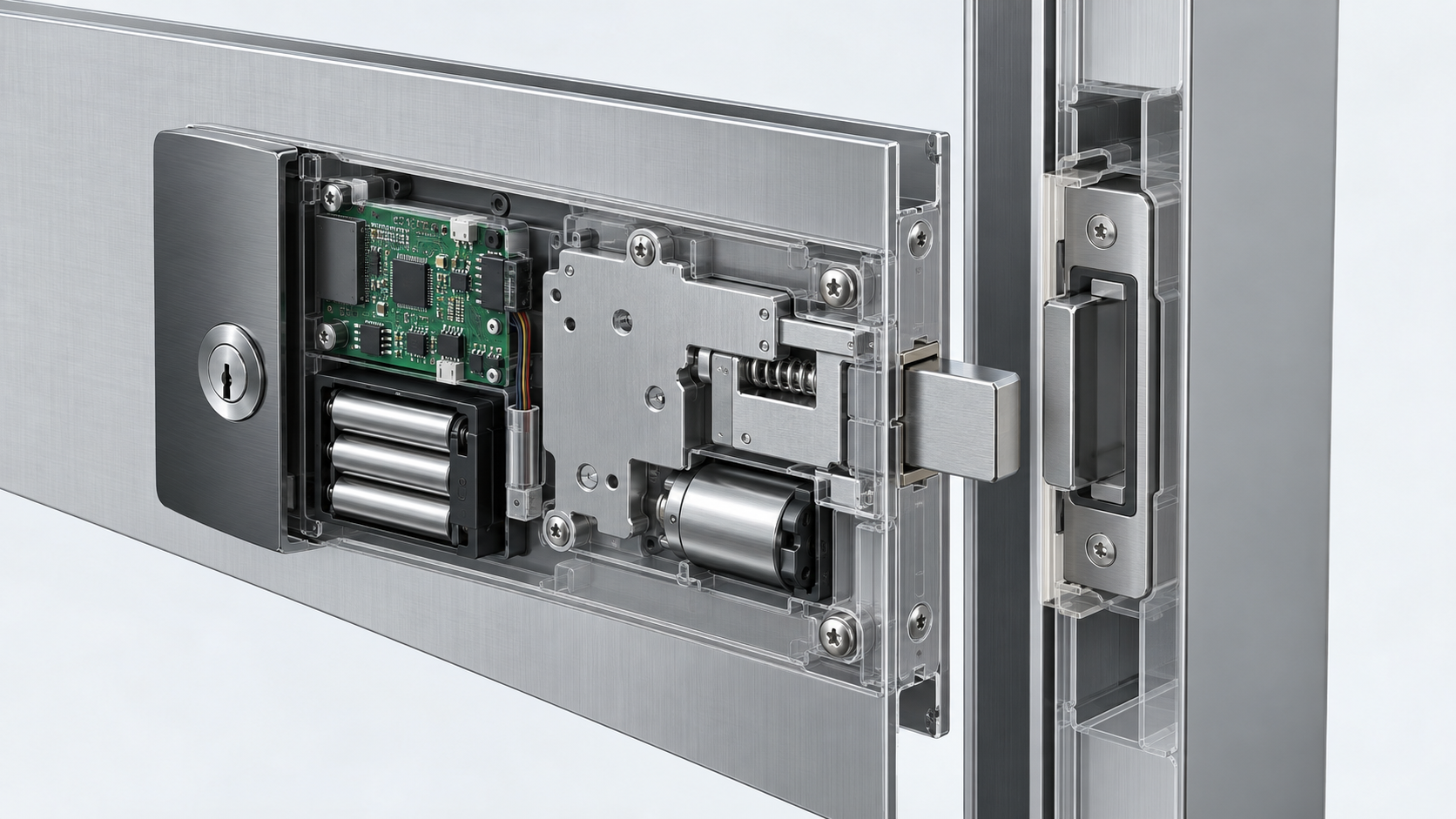
6. Use a cabinet-specific sample release gate
Require a dimensioned cabinet drawing, sample installation, closed-door RF test, low-battery test, blocked-bolt test, emergency opening test and repeated-cycle record. Document what happens after a jam, battery depletion, lost remote or controller reset.
Release criteria should identify the exact panel, keeper, lock body, PCB, firmware and battery configuration. Any change to those items returns the project to compatibility and sample verification.
7. Conclusion: feasible as a development path, not a direct substitution
WF-010 and WF-019 provide a credible starting point for discussing a custom electronic cabinet lock because they combine concealed mechanics, battery operation and wireless control. The path remains an OEM/ODM engineering project: the cabinet mechanism, mounting, service access and RF behavior require their own design and verification.
Send the cabinet drawing, material, internal clearance, required access methods, quantity and target market before choosing a donor platform or committing to tooling.
Project inquiry & OEM/ODM
Share cabinet drawings, panel material, quantities and wireless requirements so the project can define a defensible sample path.